Video Observations of Meteors in the CEMeNt and SSOVMO Networks in July and August 2026
Every year August, together with December, is one of the periods with the highest meteor activity of the year. This is mainly due to the two most active regular meteor showers: the Perseids in August and the Geminids in December. Unlike in winter, however, the August weather usually offers considerably more favorable conditions for visual observation. That is also why the Perseids are the highlight of the observing year for most observers, and their name is very well known among the general public too. In addition, overall meteor activity gradually increases over the summer. The sporadic background begins to rise after its spring minimum, which falls roughly in March and April, and during the summer several significant regular showers are added to it. Besides the dominant Perseids, showers associated with the antihelion source are also active, above all the Southern delta Aquariids and the alpha Capricornids, whose maxima occur at the turn of July and August. In the second half of August, the activity of the kappa Cygnids peaks. This shower reaches only low rates, but from an observing point of view it is exceptionally interesting for its unusually high proportion of bright meteors and fireballs. The July and August sky is therefore not only the season of the Perseids, but a very varied mix of several meteoroid populations with different orbits, velocities and physical properties.
Meteor shower activity
Perseids – the best-known shower of the summer sky
The Perseids are among the most active and at the same time best-known regular meteor showers. Their parent body is periodic comet 109P/Swift–Tuttle with an orbital period of about 133 years. The shower is active from the second half of July until the end of August, and its maximum usually occurs around 12–13 August. Under favorable conditions it reaches a ZHR of about 100 meteors (the hourly rate corrected to a radiant at the zenith). The Perseids are fast meteors: they enter the Earth's atmosphere at a geocentric velocity of about 59 km/s. They often leave bright trails, and among them there are also spectacular fireballs. The particle stream is not homogeneous but contains a number of denser dust structures created during individual returns of the parent comet. This is why some years bring short-term increases in activity or pronounced outbursts. Notable examples were the returns in the early 1990s, when the activity was linked to the most recent perihelion passage of comet Swift–Tuttle. For observers in Central Europe, the Perseids have a very favorable radiant position, high above the horizon practically all night.
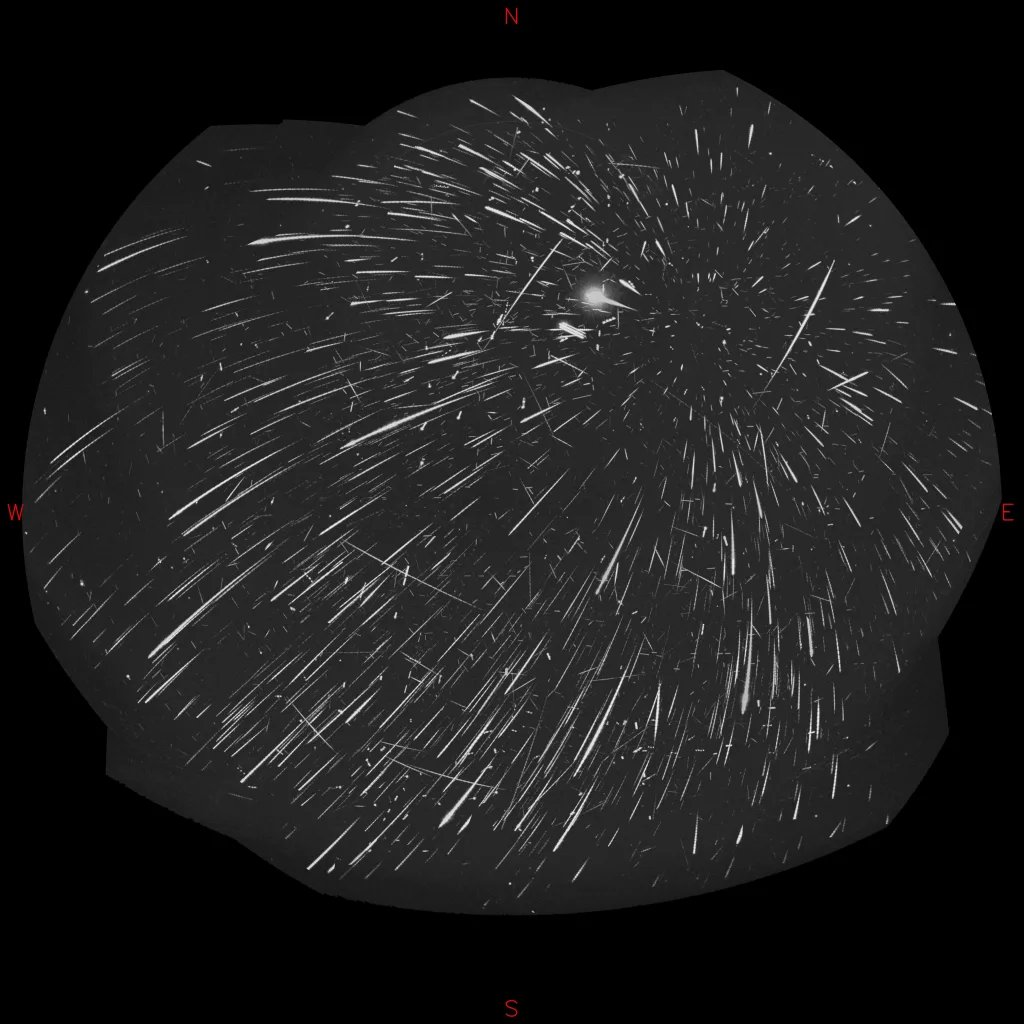
Fig. 1: Combined composite image of meteors recorded by the cameras at the Valašské Meziříčí station (cameras NE, NW, SW and SE) during the nights of 12/13 and 13/14 August 2026 during the maximum of the Perseid meteor shower; the cameras captured 2,932 meteors during this period. Credit: Valašské Meziříčí Observatory.
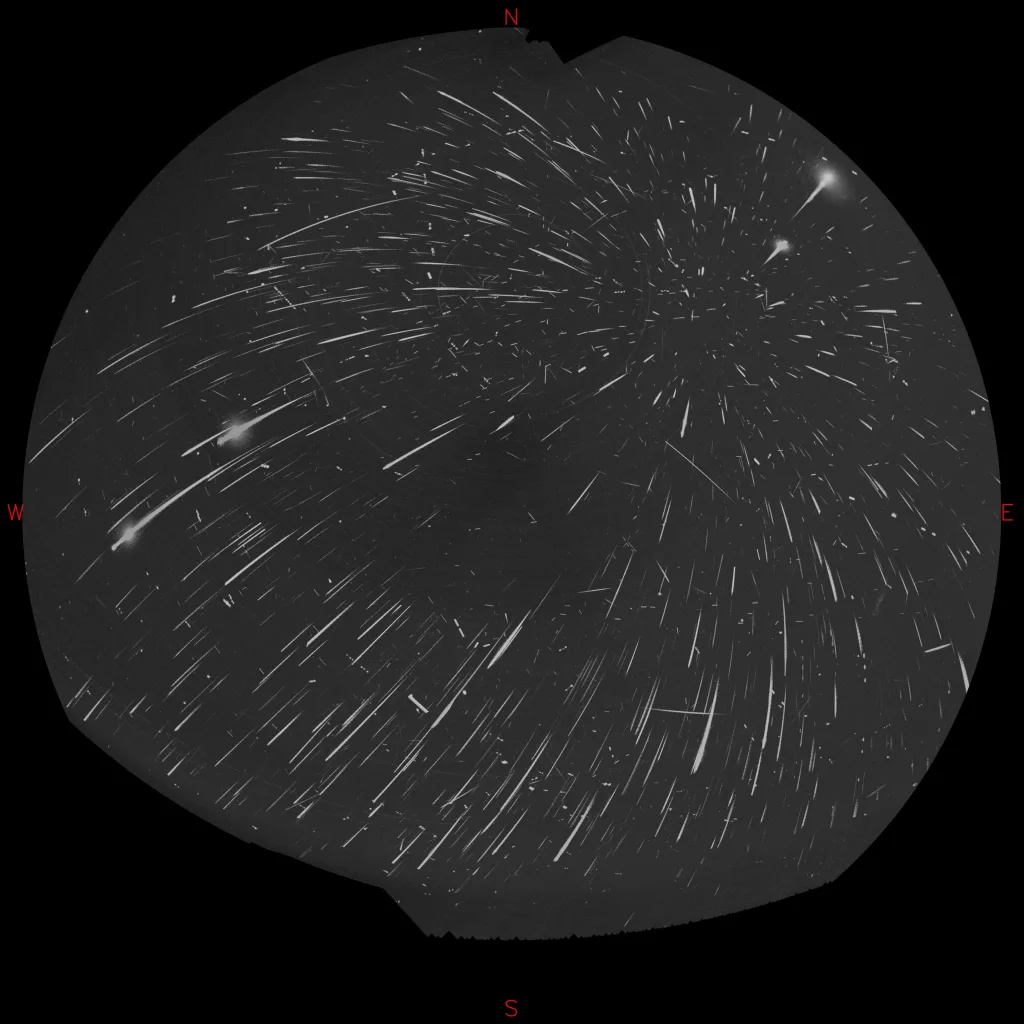
Fig. 2: Combined composite image of meteors recorded by the cameras at the Brno station (cameras NE, NW, SW and SE) on the night of 12/13 August 2026 during the maximum of the Perseid meteor shower; the cameras captured 1,614 meteors during this period. Credit: Brno Observatory and Planetarium.
Antihelion source – dominating the southern sky
However, other meteor showers also contribute to the high meteor activity in July and August. A significant active region is the so-called antihelion source , which in this period consists mainly of the delta and iota Aquariid showers , both of which have a northern and a southern branch. During July and August the extensive radiant of the antihelion source moves through the constellation of Aquarius , and at the end of August it shifts into the constellation of Pisces. The strongest component is the Southern delta Aquariids. A drawback when observing them from Central Europe is the low altitude of the radiant, which culminates only about 25° above the southern horizon. This is precisely why observations of this shower are so valuable from the Southern Spectroscopic Observatory of the Valašské Meziříčí Observatory (SSO VMO) , where the radiant of the Southern delta Aquariids passes practically through the zenith.
Southern delta Aquariids – an old stream of the comet Machholz 1 complex
The Southern delta Aquariids are among the most significant meteor showers of the second half of July. Their activity continues into the second half of August, and the broad maximum usually occurs around 30–31 July. The maximum ZHR reaches about 20–25 meteors and the geocentric velocity of the meteors is about 41 km/s. The shower is more prominent mainly from the southern hemisphere, because for observers in Central Europe its radiant in Aquarius lies low above the southern horizon. The main source of the stream is considered to be comet 96P/Machholz 1 and the whole shower is part of an extensive and dynamically very intricate complex . The material of the Southern delta Aquariids is probably very old and may have been released from the parent body as long as tens of thousands of years ago. The shower contains a large number of small particles and is therefore also very prominent in radar observations. It is a typical example of a dynamically evolved particle stream whose present orbit has already moved significantly away from the simple form of the parent body's original orbit.
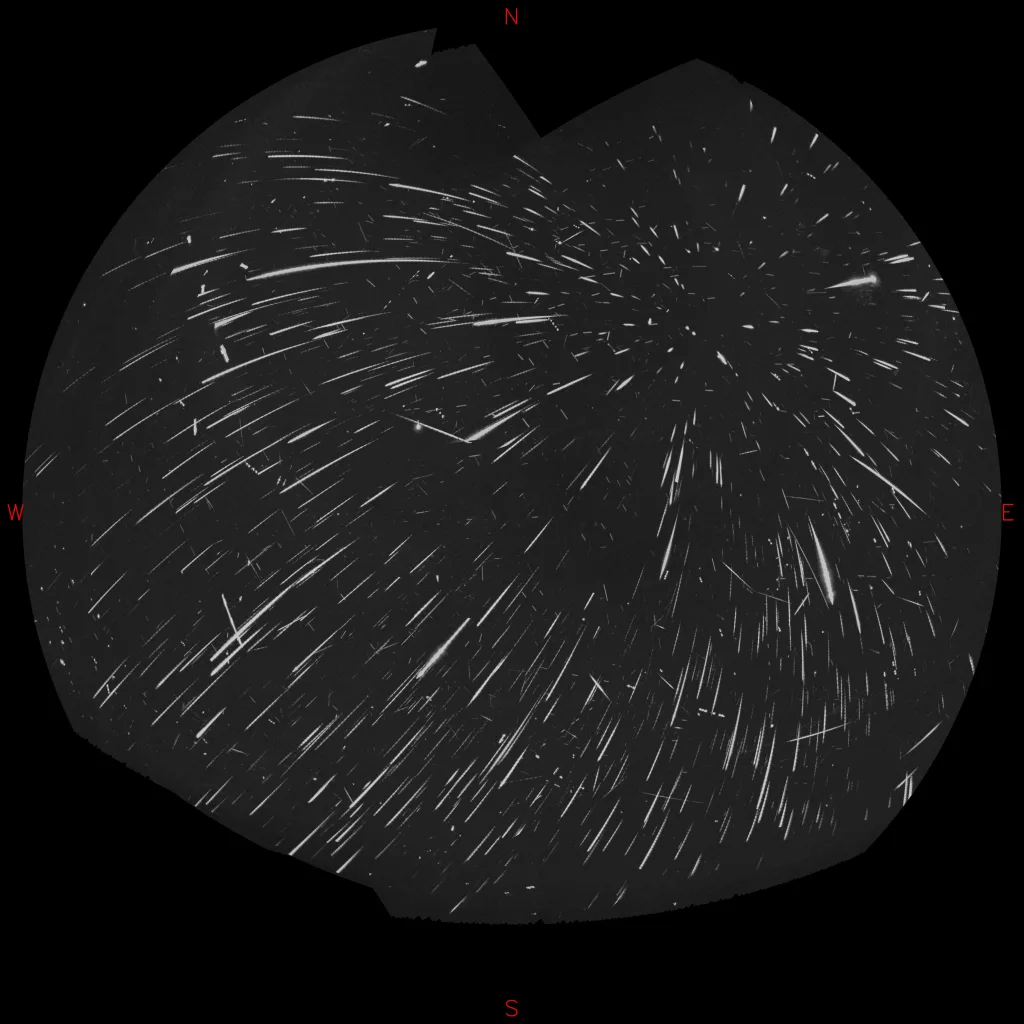
Fig. 3: Combined composite image of meteors recorded by the cameras at the Blahová station (cameras N, S, W and E) on the night of 12/13 August 2026 during the maximum of the Perseid meteor shower; the cameras captured 1,597 meteors during this period. Credit: UMa Astronomy, o.z.
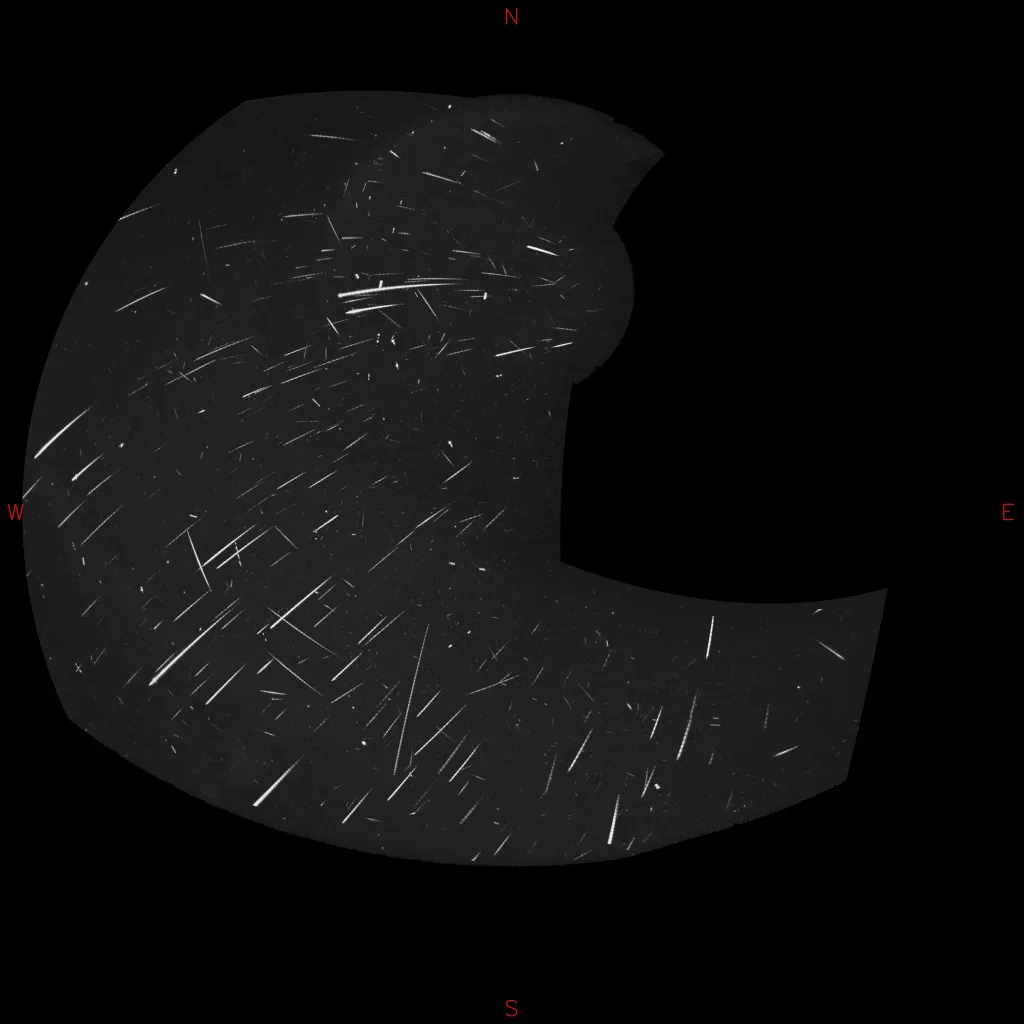
Fig. 4: Combined composite image of meteors recorded by the cameras at the Vrchteplá mobile station (cameras NW and SW) on the night of 14/15 August 2026, shortly after the maximum of the Perseid meteor shower; the cameras captured 569 meteors during this period. Credit: Jakub Koukal
Alpha Capricornids – slow meteors and bright fireballs
In terms of hourly rates the alpha Capricornids are a fairly weak meteor shower, but they make up for their low activity with a high proportion of bright meteors and fireballs. Their maximum occurs at the turn of July and August, and the usual ZHR is only about 5 meteors. The meteoroids enter the atmosphere at a velocity of about 23 km/s , so their motion across the sky is considerably slower than that of the Perseids. The parent body is considered to be comet 169P/NEAT. Dynamical models show that roughly 4,500–5,000 years ago the original body may have undergone extensive fragmentation , which created a large part of today's particle stream. At present the Earth crosses only its outer edge. It is precisely because of the presence of larger particles that the alpha Capricornids are very interesting targets for fireball cameras and spectrographs . Their radiant lies in Capricornus fairly low above the southern horizon, so from Central Europe we observe only part of their real activity.
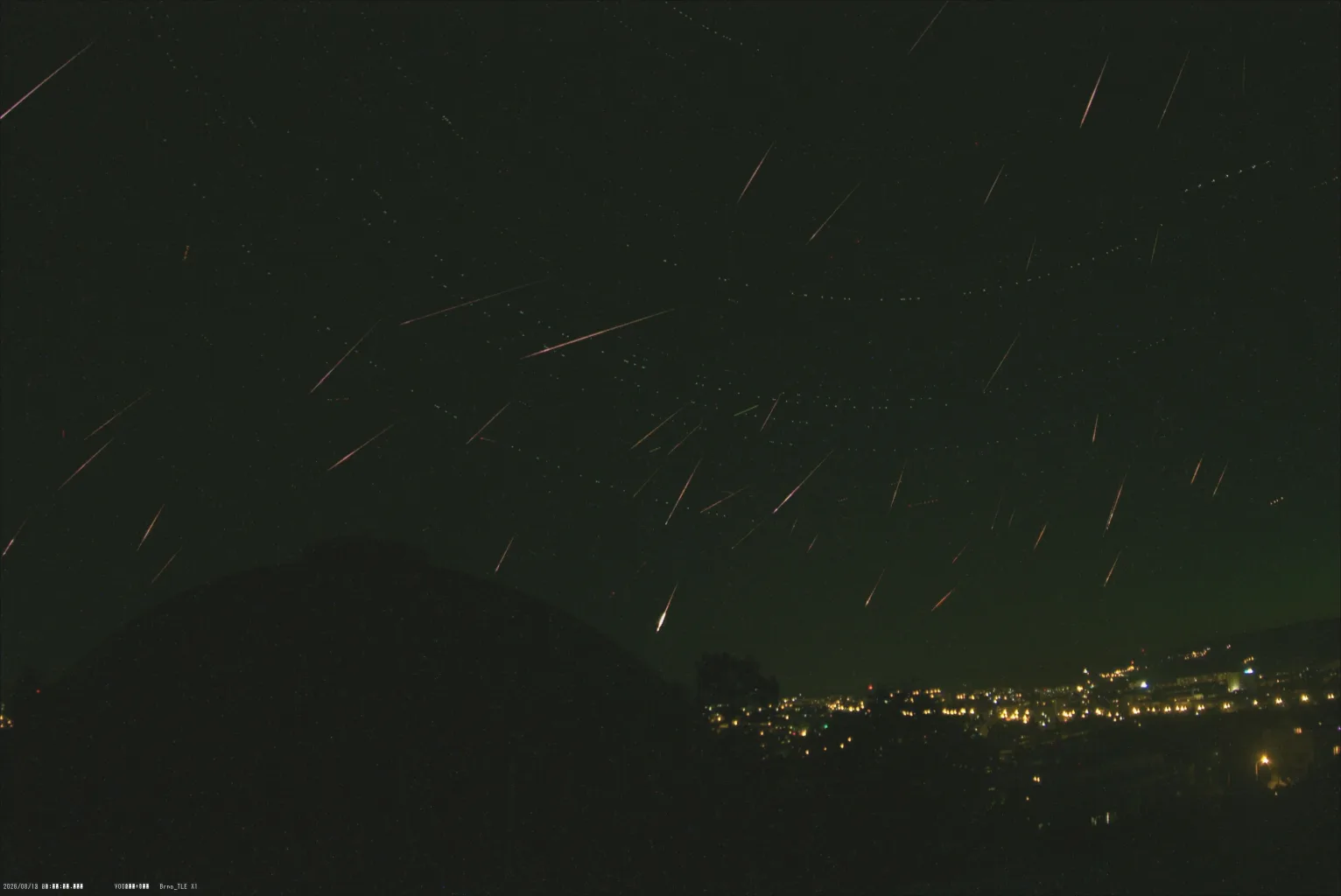
Fig. 5: Composite image of meteors recorded by the rotating TLE camera at the Brno station (camera N) on the night of 12/13 August 2026 during the maximum of the Perseid meteor shower; the camera captured 46 meteors during this period. Credit: Brno Observatory and Planetarium.
Kappa Cygnids – a mysterious shower of bright fireballs
The kappa Cygnids are among the most interesting minor meteor showers of the summer sky. Their usual activity is low, with a maximum ZHR of only about 3 meteors , yet they are known for an unusually high proportion of bright meteors and fireballs. The meteors are slow, with a velocity of about 24 km/s , and often show pronounced flares or fragmentation. The maximum of activity falls roughly in mid-August. For a long time the asteroid 2008 ED69 was considered a possible parent body, but more recent analyses show that this object is more likely related to the August Draconids. The actual parent body of the kappa Cygnids therefore remains unknown. Moreover, the shower is dynamically very unusual: its particles are trapped in a 5:3 resonance with Jupiter and enhanced activity recurs in roughly a seven-year cycle. Analyses of fireballs show that kappa Cygnid particles are very fragile and typically cometary in nature. For Central Europe the observing conditions are very good thanks to the high radiant in the region of Cygnus.
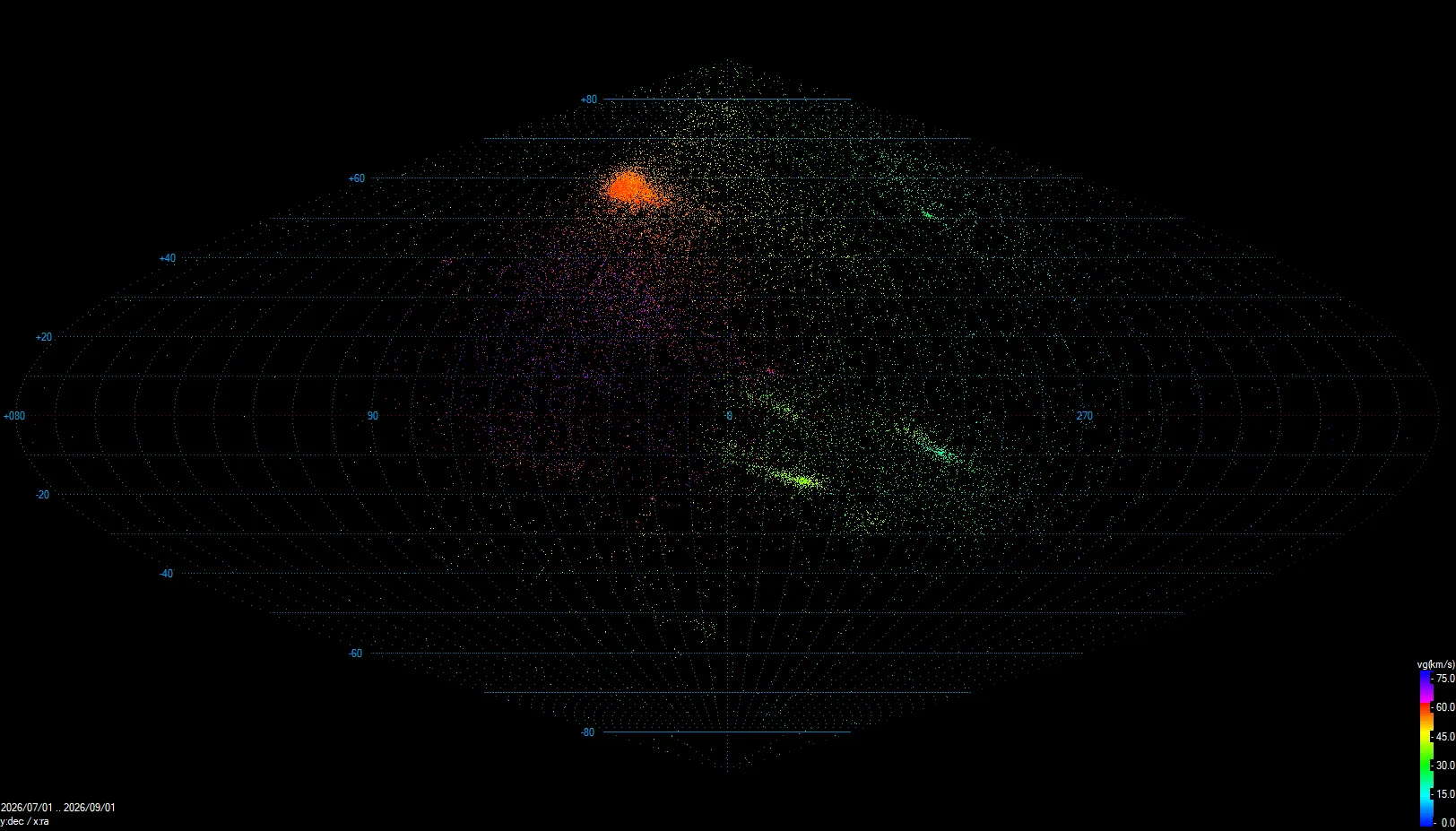
Fig. 6: Radiants of both shower and sporadic multi-station meteors recorded in the CEMeNt and SSOVMO networks in July and August 2026. A sinusoidal projection with the equatorial coordinate system is used for display. Credit: Jakub Koukal, Alexandra Mikušková
Overview of video observation in the CEMeNt and SSOVMO networks
In July 2026 , the cameras of the CEMeNt ( Central European Meteor Network ) and SSO VMO ( Southern Spectroscopic Observatory of the Valašské Meziříčí Observatory ) networks recorded 44,709 single-station meteors , which combined into 6,883 multi-station orbits. The CEMeNt network cameras recorded 29,840 single-station meteors , which combined into 5,113 multi-station orbits (Fig. 7 and 8), and the SSO VMO network cameras recorded 14,869 single-station meteors , which combined into 1,770 multi-station orbits (Fig. 9 and 10). Observation within the SSO VMO network was affected by devastating floods , which put the El Sauce station out of operation for a month.
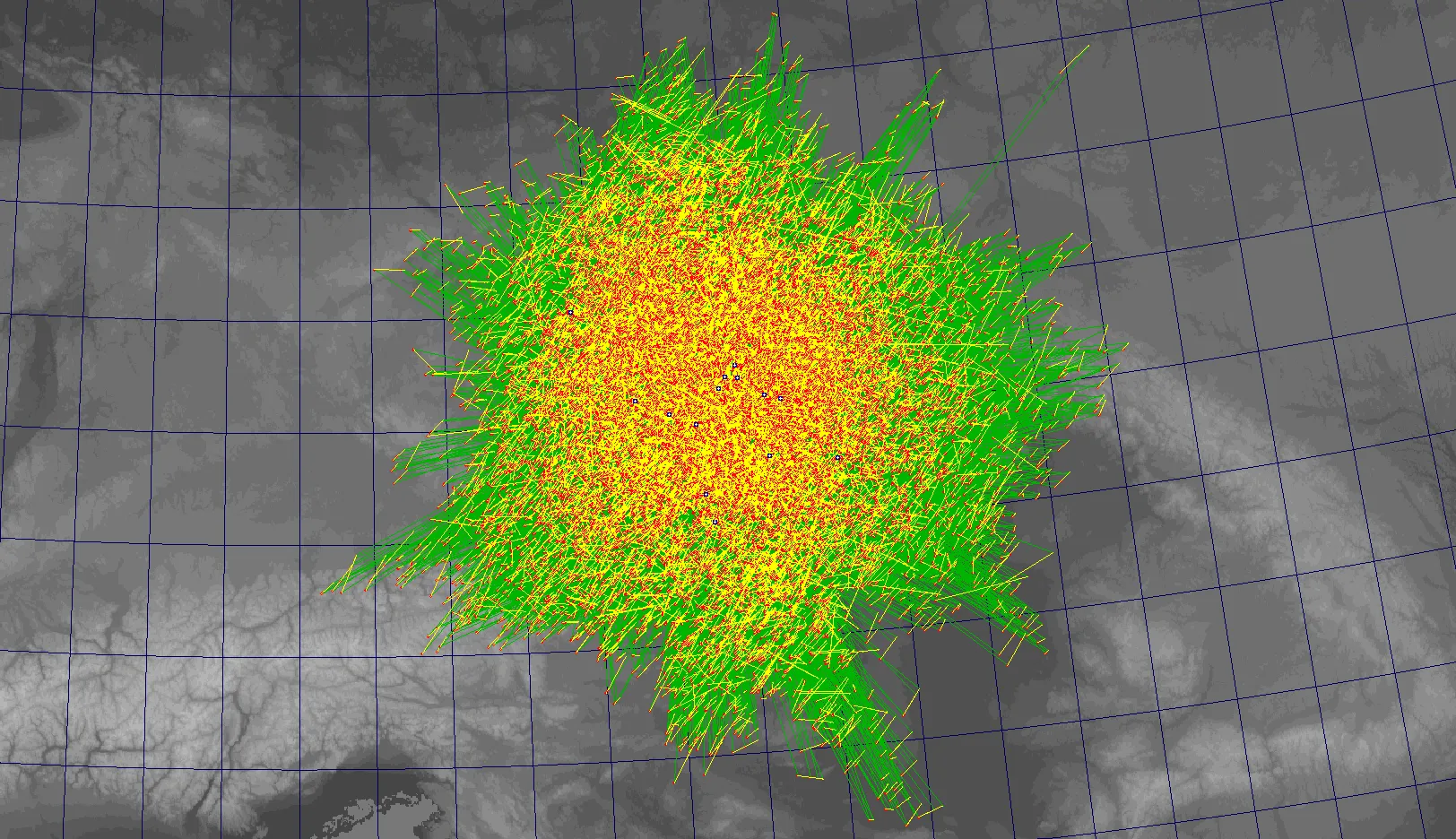
Fig. 7: Overall 2D projection of the multi-station atmospheric trajectories recorded in the CEMeNt network in July and August 2026. Credit: Jakub Koukal, Alexandra Mikušková
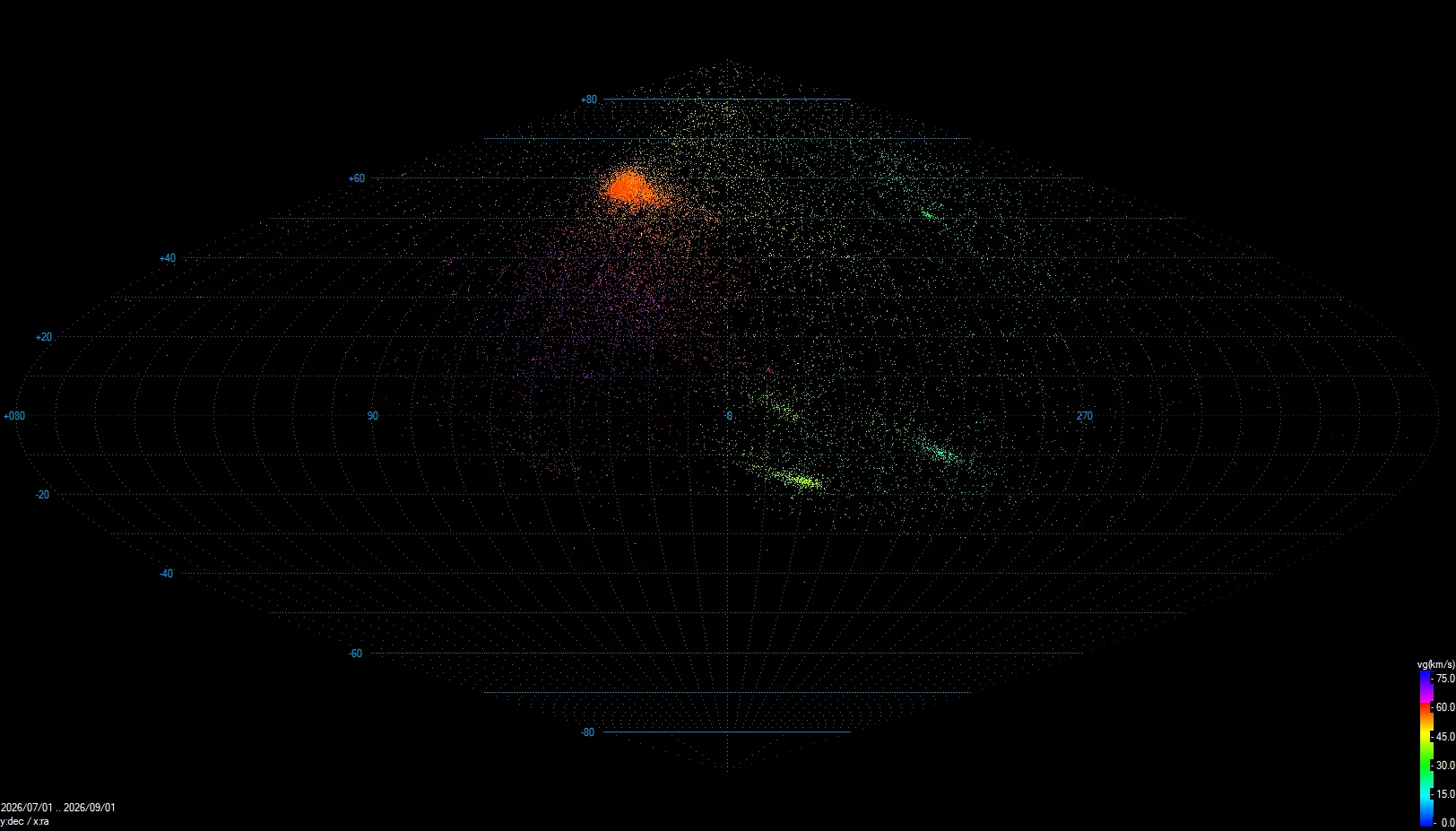
Fig. 8: Radiants of both shower and sporadic multi-station meteors in the CEMeNt network in July and August 2026. A sinusoidal projection with the equatorial coordinate system is used for display. Credit: Jakub Koukal, Alexandra Mikušková
In August 2026 , the cameras of the CEMeNt ( Central European Meteor Network ) and SSO VMO ( Southern Spectroscopic Observatory of the Valašské Meziříčí Observatory ) networks recorded 94,724 single-station meteors , which combined into 15,305 multi-station orbits. The CEMeNt network cameras recorded 79,510 single-station meteors , which combined into 14,043 multi-station orbits (Fig. 7 and 8), and the SSO VMO network cameras recorded 15,214 single-station meteors , which combined into 1,262 multi-station orbits (Fig. 9 and 10). Observation within the SSO VMO network was affected by devastating floods , which put the El Sauce station out of operation for a month.
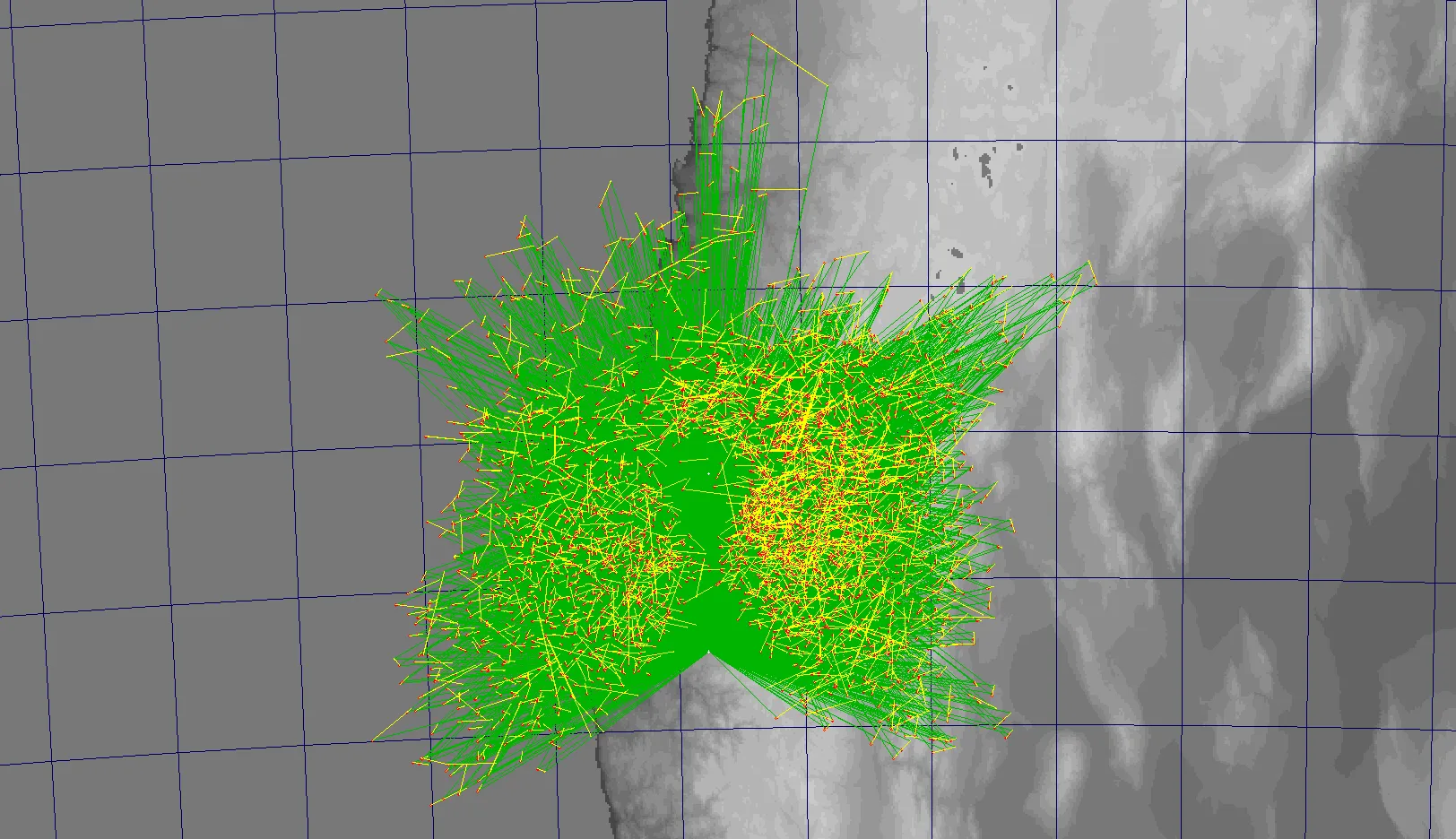
Fig. 9: Overall 2D projection of the multi-station atmospheric trajectories recorded in the SSOVMO network in July and August 2026. Credit: Jakub Koukal, Alexandra Mikušková
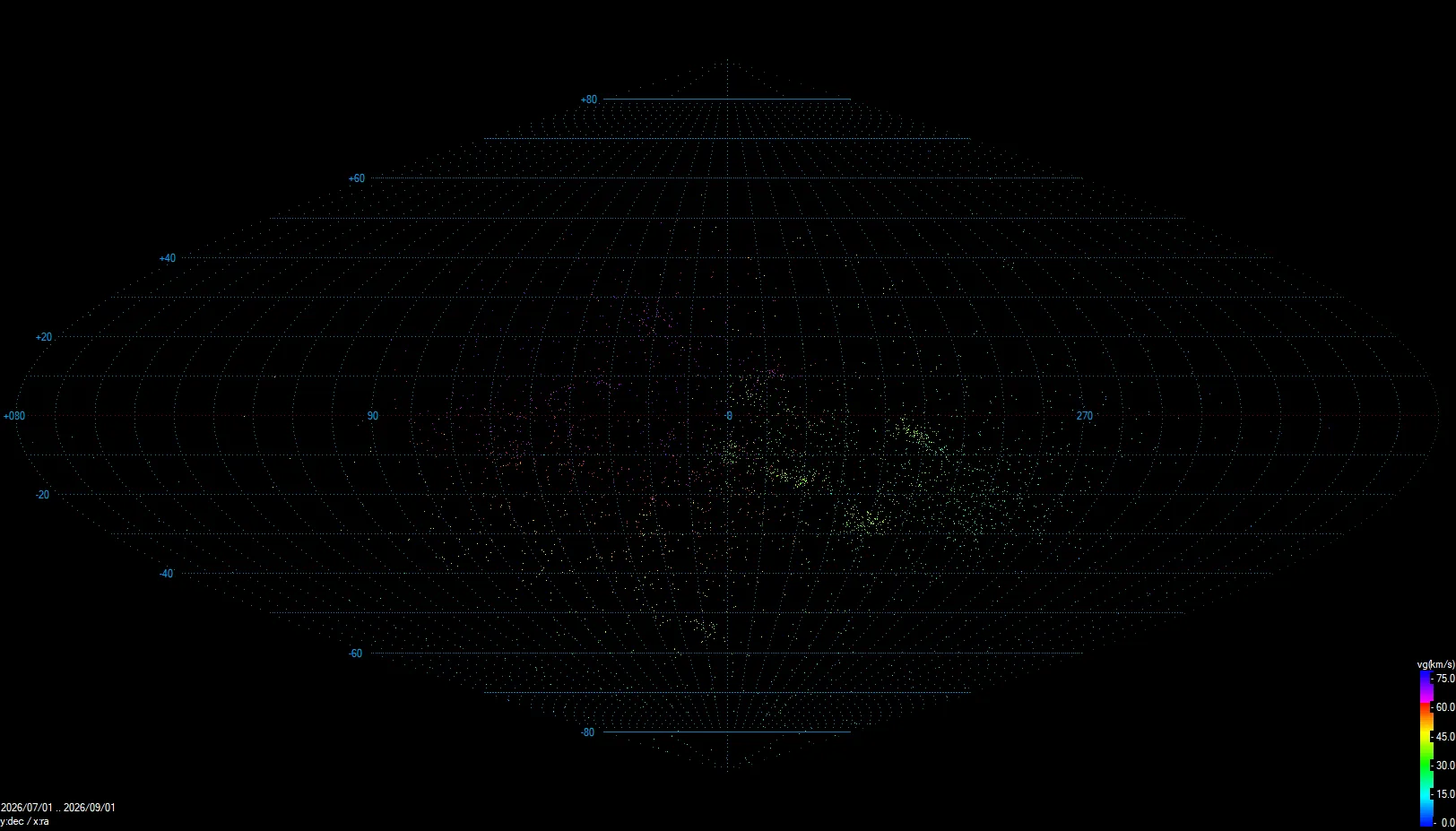
Fig. 10: Radiants of both shower and sporadic multi-station meteors in the SSOVMO network in July and August 2026. A sinusoidal projection with the equatorial coordinate system is used for display. Credit: Jakub Koukal, Alexandra Mikušková
Most of the multi-station orbits within the CEMeNt and SSOVMO networks belong to the sporadic background (13,108 orbits), followed by the Perseid meteor shower (PER, 6,185 orbits, Fig. 11), the Southern delta Aquariids (SDA, 536 orbits, Fig. 12), the alpha Capricornids (CAP, 343 orbits), the Northern delta Aquariids (NDA, 182 orbits), the Southern mu Sagittariids (NZC, 135 orbits), the Southern June Aquilids (SZC, 100 orbits), the Northern June Aquilids (ZCS, 78 orbits), the kappa Cygnids (KCG, 75 orbits) and the August iota Cetids (AIC, 74 orbits), followed by further weaker meteor showers whose number of multi-station orbits was lower than 70. The number of single-station meteors (as well as of multi-station orbits) in August 2026 is the highest ever within the CEMeNt network for the whole of its existence since 2009.
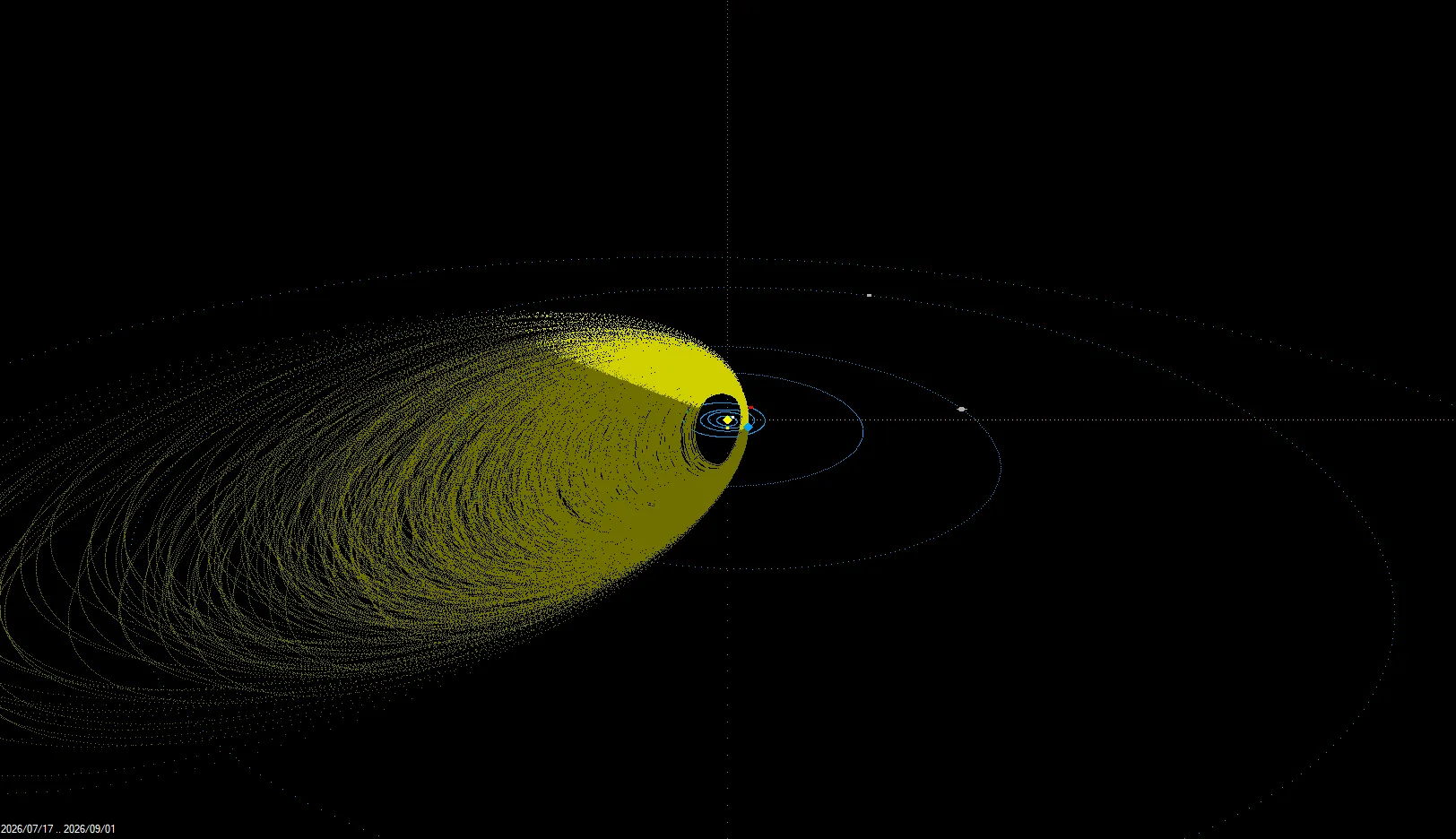
Fig. 11: 3D projection of the heliocentric multi-station orbits of meteors belonging to the Perseid (PER) meteor shower within the Solar System. A total of 6,185 multi-station orbits of the PER meteor shower were recorded in July and August 2026 within the CEMeNt network. Credit: Jakub Koukal, Alexandra Mikušková
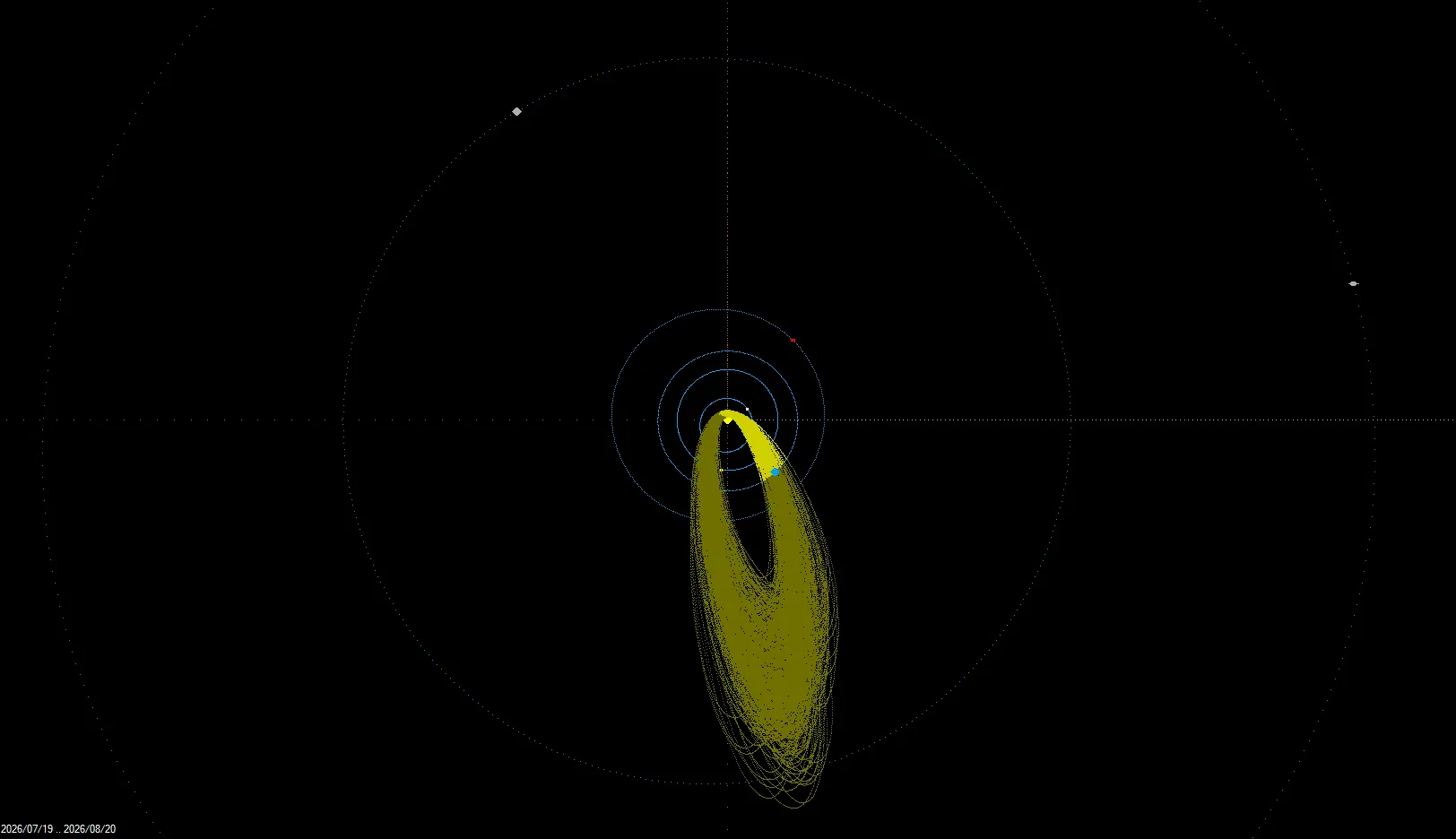
Fig. 12: 3D projection of the heliocentric multi-station orbits of meteors belonging to the Southern delta Aquariid (SDA) meteor shower within the Solar System. A total of 536 multi-station orbits of the SDA meteor shower were recorded in July and August 2026 within the CEMeNt network. Credit: Jakub Koukal, Alexandra Mikušková
The pairing efficiency within the CEMeNt network ranged from 68.9% in July to 74.5% in August ; the installation of new network cameras showed itself in an increased pairing efficiency. In August the station/orbit ratio reached 4.22, which is the highest value ever within the CEMeNt network.
The pairing efficiency within the SSOVMO network ranged from 29.3% in July to 19.7% in August . The pairing efficiency and the station/orbit ratio were affected by the catastrophic floods in the region.
In total, this year to date (as of 31 August 2026), 332,733 single-station meteors have been recorded, which combined into 56,562 multi-station orbits (Tab. 1).
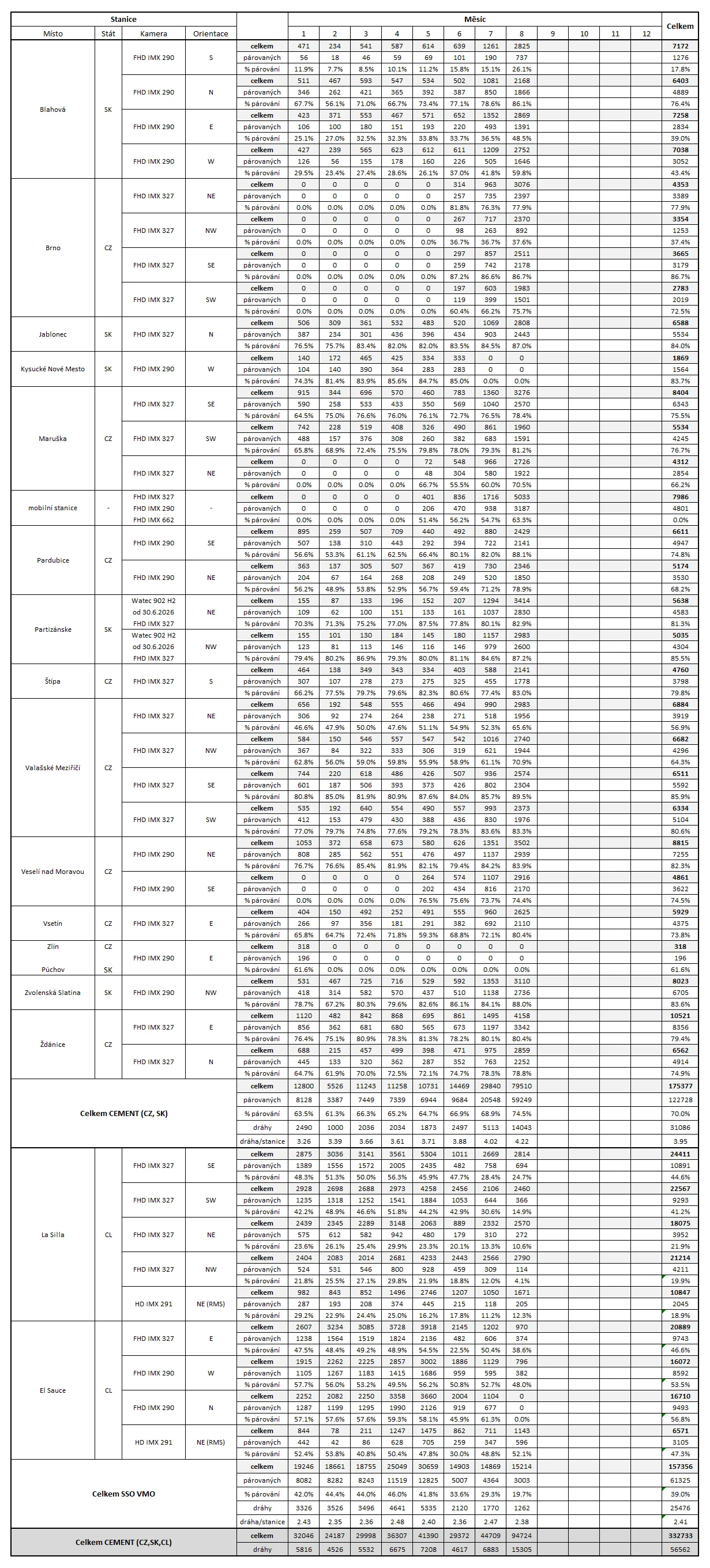
Tab. 1: Overview of the number of recorded and paired meteors in 2026 at the stations of the CEMeNt and SSOVMO networks. Credit: Jakub Koukal, Alexandra Mikušková
Acknowledgements
Our thanks go to the companies DEZA , a. s. and CS CABOT , spol. s r. o., which contributed to the purchase of equipment for the FHD station located at the Valašské Meziříčí Observatory and also within the CEMeNt network. Thanks also go to all partner observatories (Ždánice, Vsetín, Brno, Rokycany, Plzeň, Karlovy Vary, Partizánske, Kysucké Nové Mesto) and to the private station owners (Milan Čermák, Richard Kačerek, Jakub Kapuš, Tibor Csorgei, Vladimír Bahýl, Ivo Míček) for supporting the activities and growth of the network. Thanks also go to all involved institutions for supporting the activities and growth of the network. The RPOS (Development of the Cross-Border Observation Network) project was co-financed by the Small Project Fund of the Interreg V-A Slovak Republic – Czech Republic 2014–2020 program, call code 5/FMP/11b, reg. no. CZ/FMP/11b/05/058. The KOSOAP (Cooperating Network in the Field of Astronomical Specialist Observation Programs) and RPKS (Development of the Cross-Border Cooperating Network for Specialist Work and Education) projects were carried out by the Valašské Meziříčí Observatory (CZ) and the Kysucké Nové Mesto Observatory (SK) in cooperation with the SMPH (Society for Interplanetary Matter). The projects were co-financed by the Microprojects Fund of the Operational Program of Cross-Border Cooperation Slovak Republic – Czech Republic 2007–2013. The project for the purchase and operation of high-resolution spectroscopic cameras is partly funded by the Regional Cooperation Program of the Czech Academy of Sciences, reg. no. R200402101. The installation of the Southern Spectroscopic Observatory of the Valašské Meziříčí Observatory in Chile is part of the KKC (Cultural and Creative Center) project, co-financed by the European Union and the National Recovery Plan, under call no. 0231/2022 – Development of Regional Cultural and Creative Centers (project reg. no. 0231000014), administered by the Ministry of Culture of the Czech Republic. The installation costs were covered by co-financing provided by the Zlín Region. We thank the PLATOSpec consortium for supporting us and for providing the opportunity to install the spectral cameras, as well as for cooperation during installation and operation. The PLATOSpec project was built and is operated by a consortium composed of the Astronomical Institute of the Czech Academy of Sciences in Ondřejov (ASU), the Thuringian State Observatory (Thüringer Landessternwarte, Germany), the Pontifical Catholic University of Chile (PUC, Chile); smaller partners include Masaryk University (Czech Republic), Adolfo Ibáñez University (Chile) and the Institute of Plasma Physics of the Czech Academy of Sciences (Czech Republic). Funding for the modernization of the 1.52m telescope was provided by ASU, and personnel costs were partly covered by grant LTT-20015. Funding for the construction of PLATOSpec was provided by the Free State of Thuringia, represented by the "Thuringian Ministry of Education, Science and Culture" under the "Research Support Directive", and by the German Aerospace Center (DLR). Financial support for the observations is provided within the institutional support for the development of the research organization of Masaryk University. The use of the 1.52m telescope was made possible through an agreement between ESO and the PLATOSpec consortium. The installation of the El Sauce station was made possible at the private El Sauce Observatory in cooperation with OBSTECH SpA .
author: Jakub Koukal, Alexandra Mikušková