NASA APOD: “Mostly Perseids” as Astronomy Picture of the Day
On Saturday, August 22, 2026, NASA’s APOD (Astronomy Picture of the Day) featured “Mostly Perseids,” an image created at the Valašské Meziříčí Observatory. It was assembled from data recorded on the night of August 12–13, 2026, by four specialized meteor cameras in the CEMeNt (Central European Meteor Network) network. The all-night composition contains 1,706 meteors. It immediately reveals the dominance of the Perseid meteor shower while also showing weaker showers, including the kappa Cygnids and the antihelion complex. Images from the four cameras were aligned and combined into an all-night, all-sky view. Behind that simple description lies the work of solving wide-angle camera geometry, registering stars, separating the stable background from transient phenomena, and combining multiple fields of view. The custom Meteor Star Stacker program was developed for this purpose—and it produced the image that reached one of the world’s most widely viewed astronomy websites.
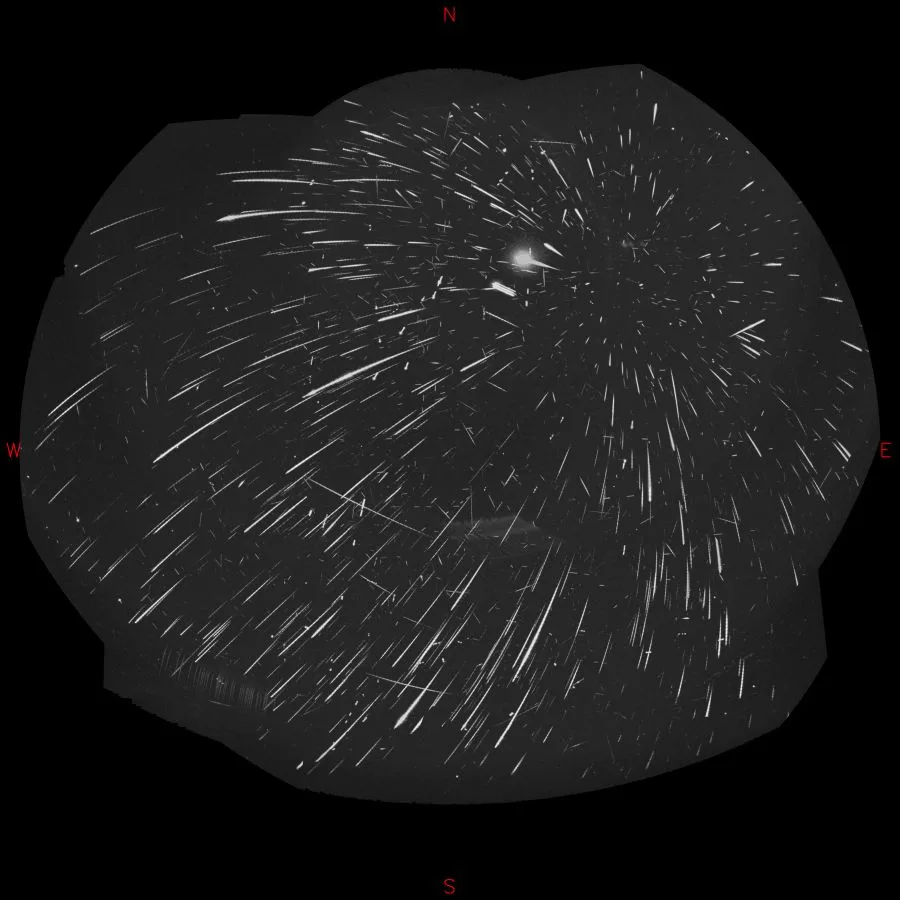
Final “Mostly Perseids” APOD (August 22, 2026). Source: NASA APOD 2026 August 22; download the image at its original resolution (4457×4457 px) here. Author: Jakub Koukal (Valašské Meziříčí Observatory).
What exactly is APOD?
APOD stands for Astronomy Picture of the Day. Its underlying idea has remained remarkably simple from the beginning: each day, it publishes one astronomical photograph, image, animation, or other visualization of the universe, accompanied by a short explanation written by a professional astronomer. The project began on June 16, 1995, and has long been produced and edited by astrophysicists Robert Nemiroff and Jerry Bonnell. In June 2025, APOD celebrated 30 years of continuous operation.
APOD is a NASA-supported project, and its main website runs on NASA infrastructure. It is worth clarifying, however, that APOD is not a conventional competition or photography award. Authors and institutions submit their images to the editors, who select material suitable for a daily public outreach and educational presentation. Having an image selected for a particular day is therefore not a formal competitive “win,” but it does provide exceptionally valuable international exposure for the author, the observatory, and the project behind the image.
Over more than three decades, APOD has built an extensive chronological archive, which it describes as the largest collection of annotated astronomical images on the internet. Its content also reaches audiences through many translated editions, social networks, and other platforms; the officially listed translations include a Czech version. APOD thus connects professional astronomy, amateur observations, space missions, observatories, and scientific visualization with a very broad audience.
“Mostly Perseids”: one night, 1,706 meteors
The August 22, 2026 APOD captures the night of the Perseid meteor shower maximum, August 12–13. The 1,706 meteors shown are not a photographic record from one long exposure. Instead, this is a time-spanning composition in which individual meteor records were transformed into a shared celestial geometry. This makes the Perseid radiant immediately recognizable: when their trails are extended backward, they converge on one region in the constellation Perseus.
The same principle makes much weaker meteor populations visible among the dense field of Perseids. These include the kappa Cygnids, with their radiant in the constellation Cygnus (along with other nearby showers following similar trajectories), and the antihelion complex. Its meteors arrive from a part of the sky roughly opposite the Sun, and at that time their radiants were located in the constellation Aquarius. The result is more than a striking mosaic of “shooting stars”: it is a visual map of meteor-shower activity throughout the night.
Why wasn’t simply stacking the images enough?
At first glance, the task seems straightforward: take every image containing a meteor, align the frames using the stars, and combine them into one picture. With wide-angle meteor cameras, however, the situation is considerably more complex. The camera is installed in a fixed position, while objects in the sky change position during the night because of Earth’s rotation, so the stars are continually moving across the camera sensor. The field of view is wide, the lens has measurable distortion, and individual frames may include the Moon, a changing background, aircraft, fixed objects in the field of view, or only a small number of sufficiently bright stars.
The conventional approach of solving every frame astrometrically and independently proved unnecessarily fragile. The goal was not merely to create an impressive image, but to build a geometrically reproducible system: the same stationary camera must produce the same result with the same processing, even weeks or months later. At the same time, it was necessary to preserve the true appearance of the meteors, including bright fireballs, and to apply as little cosmetic alteration as possible to the real sky.
How images from one camera are stacked
Each camera is processed separately at first. The program creates a valid-data mask, removing the time and system overlay, the Moon’s disk where necessary, the physical edge of the sensor, and any fixed object in the field of view, such as the edge of a roof or a lightning conductor. In the final production pipeline, stable hot pixels—defects in the sensor structure—are corrected before geometric reprojection. They are identified as small defects fixed to the camera sensor across several frames distributed over time and then locally reconstructed in every input image. This matters because, after transformation into celestial geometry, a single defective pixel could turn into a dashed arc in the meteor layer.
Once cleaned, each frame is reprojected only once into a shared celestial projection. The Full Footprint mode preserves the entire real fan-shaped area of sky covered by the camera during the night, rather than only a rectangle matching the original frame. This is followed by smooth additive background normalization, which suppresses large-scale differences caused by haze, changing sky brightness, or gradients, but is not intended to artificially equalize the real scene photometrically.
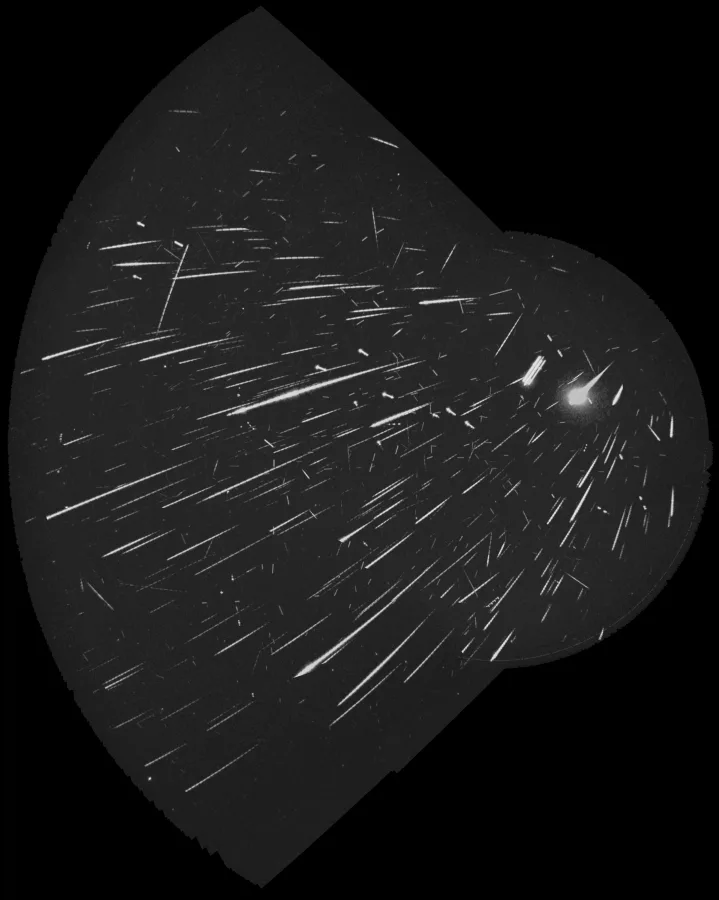
Figure 1: Composite of meteors recorded by the Valašské Meziříčí NW camera in a fixed azimuthal equidistant projection. Author: Jakub Koukal (Valašské Meziříčí Observatory).

Figure 2: The total fields of view of the individual cameras and their overlaps in a shared fixed azimuthal equidistant projection (pseudo all-sky). Author: Jakub Koukal (Valašské Meziříčí Observatory).
Pseudo all-sky: four cameras working as one
The “Mostly Perseids” APOD is the product of this additional processing layer. The Pseudo All-Sky module is not a second stacking algorithm applied to the original individual meteor frames; it is an extension that operates on the already completed composite images from the individual cameras. Each camera first goes through its own calibration and sequential processing pipeline, then supplies the shared module with a separate star background, meteor layer, coverage map, validation mask, and complete projection geometry.
The individual fields of view are transformed into a shared zenith-centered azimuthal equidistant projection, with north at the top and east to the right. In overlapping areas, the star background is combined using smooth edge blending, while the meteor layers are merged using a maximum/lighten method. The program intentionally avoids globally matching the cameras’ brightness: if part of the sky is genuinely brighter because of the Moon, light pollution, or haze, that information should not be cosmetically erased.
Sources and links
APOD 2026-08-22 – Mostly Perseids
CEMeNt (Central European Meteor Network)
APOD 2025-06-16 – APOD is 30 Years Old Today
The first APOD – 1995-06-16, Neutron Star Earth
Acknowledgements
We thank DEZA, a.s., and CS CABOT, spol. s r.o., for contributing to the purchase of equipment for the FHD stations located at the Valašské Meziříčí Observatory and elsewhere within the CEMeNt network. We also thank all partner observatories (Ždánice, Vsetín, Brno, Rokycany, Plzeň, Karlovy Vary, Partizánske, and Kysucké Nové Mesto), as well as the private station owners (Milan Čermák, Richard Kačerek, Jakub Kapuš, Tibor Csorgei, Vladimír Bahýl, and Ivo Míček), for supporting the network’s activities and growth. Our thanks also go to all institutions involved in supporting these activities. The RPOS project (Development of the Cross-Border Observation Network) was co-financed by the Small Projects Fund of the Interreg V-A Slovakia–Czech Republic 2014–2020 programme, call code 5/FMP/11b, registration no. CZ/FMP/11b/05/058. The KOSOAP (Cooperating Network for Astronomical Expert Observation Programmes) and RPKS (Development of a Cross-Border Cooperating Network for Expert Work and Education) projects were carried out by the Valašské Meziříčí Observatory (Czech Republic) and Kysucké Nové Mesto Observatory (Slovakia), in cooperation with SMPH (Society for Interplanetary Matter). These projects were co-financed by the Microprojects Fund of the Slovakia–Czech Republic Cross-Border Cooperation Operational Programme 2007–2013. The purchase and operation of high-resolution spectroscopic cameras is partially supported by the Czech Academy of Sciences Regional Cooperation Programme, registration no. R200402101. The installation of the Valašské Meziříčí Observatory’s Southern Spectroscopic Observatory in Chile is part of the KKC (Cultural and Creative Centre) project, co-financed by the European Union and the National Recovery Plan under call no. 0231/2022—Development of Regional Cultural and Creative Centres (project registration no. 0231000014), administered by the Ministry of Culture of the Czech Republic. Installation costs were covered by co-financing from the Zlín Region. We thank the PLATOSpec consortium for providing space for the spectral cameras and for its cooperation during installation and operation. The PLATOSpec project was built and is operated by a consortium comprising the Astronomical Institute of the Czech Academy of Sciences in Ondřejov (ASU), the Thuringian State Observatory (Thüringer Landessternwarte, Germany), and the Pontifical Catholic University of Chile (PUC, Chile), with smaller partners including Masaryk University (Czech Republic), Adolfo Ibáñez University (Chile), and the Institute of Plasma Physics of the Czech Academy of Sciences (Czech Republic). ASU funded the modernization of the 1.52 m telescope, while personnel costs were partially covered by grant LTT-20015. Construction of PLATOSpec was funded by the Free State of Thuringia, represented by the Thuringian Ministry of Education, Science and Culture under its Research Funding Directive, and by the German Aerospace Center (DLR). Financial support for observations is provided through institutional support for the development of Masaryk University as a research organization. Use of the 1.52 m telescope was made possible by an agreement between ESO and the PLATOSpec consortium. Installation of the El Sauce station was made possible at the private El Sauce Observatory in cooperation with OBSTECH SpA.
author: Jakub Koukal