HROFFT Complex Solver: Automated Radio Meteor Analysis
Forward-scatter radio meteor observation uses the ionized trail created as a meteoroid passes through the atmosphere. For a short time, this trail reflects electromagnetic waves, allowing a receiver to detect a distant transmitter whose signal would normally remain hidden beyond Earth’s curvature. The SMRST v2 radio station produces 144 ten-minute radiograms every day. During periods of increased meteor activity, these contain hundreds or thousands of structures: real meteors, aircraft reflections, satellites, vertical impulses, periodic interference, and complex overlaps between several echoes. HROFFT Complex Solver GUI 0.5.3 was developed to turn this volume of data automatically into a clean, measurable meteor catalogue without requiring every image to be checked manually each day.
From the SMRST v2 station to a big-data problem
The SMRST v2 station has operated at the Valašské Meziříčí Observatory since November 2025. It uses the French GRAVES radar, transmitting at approximately 143.050 MHz, as its signal source. A directional five-element Yagi antenna receives the signal. After digitization by an RTL-SDR receiver, the signal passes through HDSDR to HROFFT, which continuously saves radiograms in ten-minute intervals.
This method has an important advantage: it works day and night and is not affected by cloud cover. At the same time, however, it produces data that are visually far more complex than a simple detection list. A short underdense echo from a faint meteor and sparse plasma may last only one second and occupy a few pixels. An overdense echo from a bright meteor or fireball, with a saturated radio reflection, may persist for tens of seconds, shift in frequency, and overlap the surrounding noise. The same radiogram may also contain aircraft reflections, satellites, local electrical interference, and structured Doppler profiles. Distinguishing these phenomena became the principal obstacle to long-term statistical processing.
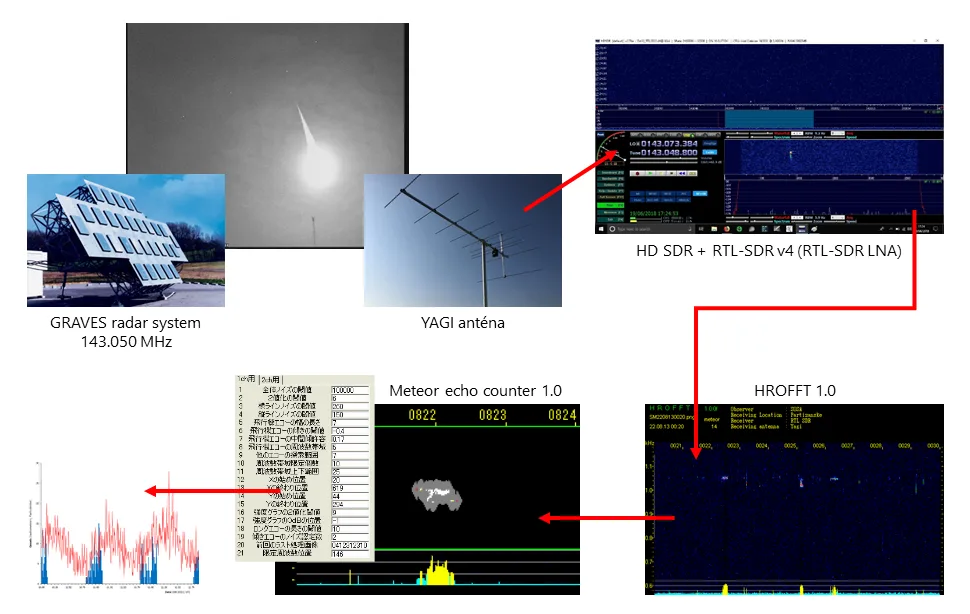
Figure 1: Functional diagram of the SMRST v2 passive meteor radar system, including the original data-processing workflow. Author: Jakub Koukal
The original functional design of the SMRST v2 system relied on MEC (Meteor Echo Counter) for automated evaluation. Practical operation showed that a much more flexible tool was needed: one capable not only of counting bright local maxima, but also of recognizing complex meteor structures, separating overlapping events, retaining faint meteors, and maintaining a very low false-detection rate.
Why a complex solver was developed
Manual radiogram inspection is possible during a short test campaign, but it is not sustainable over the long term. One radio station produces 52,560 ten-minute images per year. During active periods, a single image may contain dozens of candidate structures. Nor is the task limited to a binary “meteor or not a meteor” decision. To make comprehensive use of the data, we need the precise beginning and end of each echo, its duration, maximum intensity, integrated intensity, and area. In complex events, the system must determine whether one large box represents one meteor, several meteors, or a compound structure combining a meteor with interference.
The project therefore did not aim to create one universal classifier that would decide everything with a single score. Such an approach would be fragile: a model could easily learn a specific kind of interference from one night and then lose real meteors under different conditions. A hybrid system was developed instead. Machine learning generates and initially assesses candidates, while additional modules apply structural, topological, and physically interpretable rules. The result is a decision pipeline in which every acceptance, rejection, split, or merge can be explained retrospectively.
Three practical objectives were established at the start of solver development:
– high purity in the final catalogue, with as few aircraft, satellites, and interference structures as possible;
– retention of real meteors, including faint echoes, the marginal portions of meteor echoes, and very bright, structurally complex echoes;
– fully automated production output that can be used immediately for activity statistics, shower time profiles, and further physical analyses.
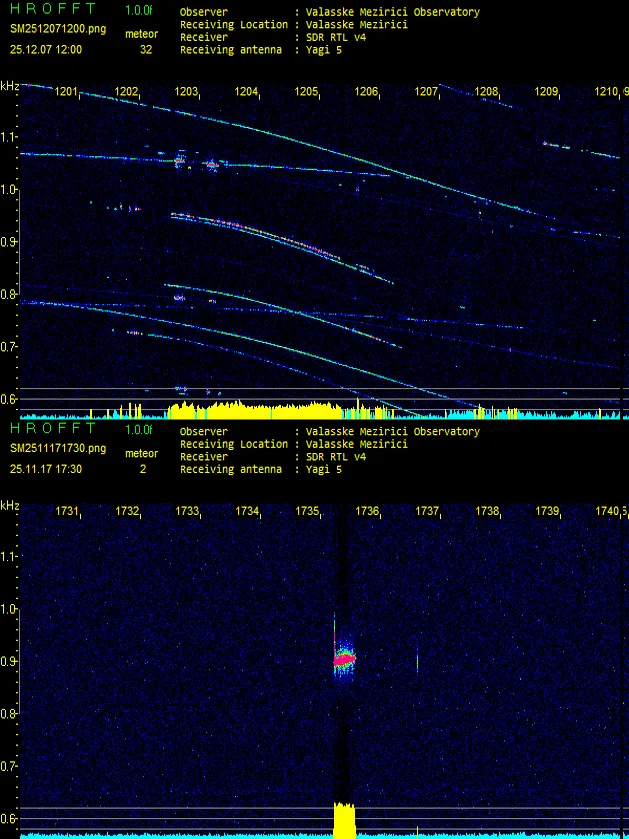
Figure 2: Two types of structure that automated processing must distinguish. Extensive structured interference—aircraft and a parasitic signal—is shown above, while a compact overdense response from a bright meteor appears below. Author: Jakub Koukal
The model used by the solver
The underlying classification model is ExtraTrees (Extremely Randomized Trees), an ensemble of many randomly generated decision trees. It is not an image-based neural network that treats a radiogram as a photograph. Instead, every candidate box is first described by a set of measurable features: length, height, area, continuity, fill ratio, centroid position, intensity profile, slope, and other parameters. The individual decision trees learn to distinguish meteor and non-meteor structures from these values. The resulting probability combines the votes of the entire tree ensemble.
The advantages of ExtraTrees include speed, good performance on nonlinear relationships, and the ability to combine very different features without complex normalization. For this application, it is also important that the classification does not remain a black box: we can inspect which candidate parameters produced a low or high probability and use them in subsequent physically motivated rules. The training data were created by manually labelling meteors, aircraft, parasitic signals, vertical bands, and other phenomena. The model was then validated on independent nights that had not been used to develop the given version.
The model alone is not the complete solver. Its role is to produce a strong proposal and probability. Other modules determine the correct number of physical events, perform precise measurements, and complete the final deduplication.
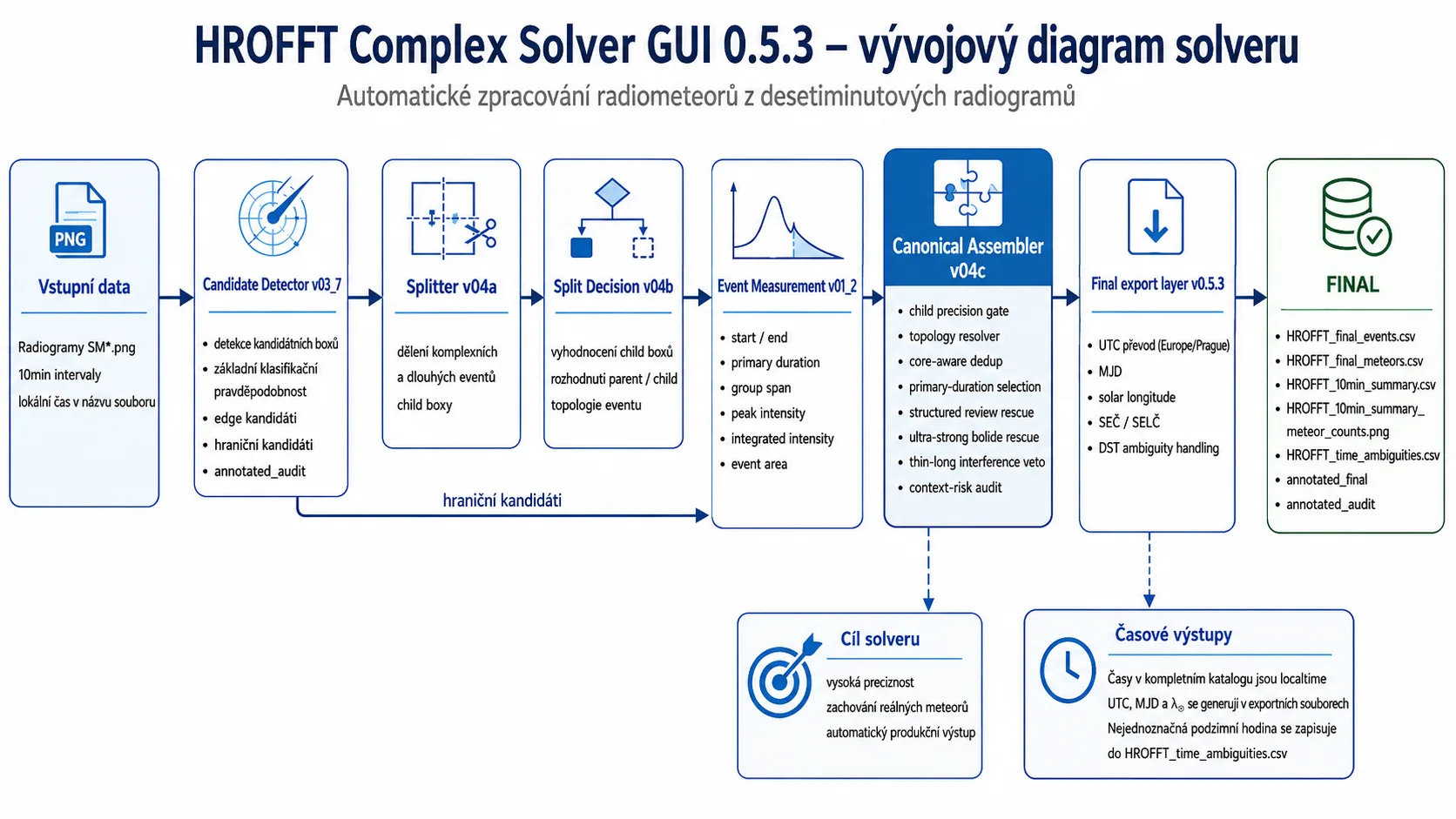
Figure 3: Overall flowchart of HROFFT Complex Solver GUI 0.5.3. The solver combines machine learning, complex-event splitting, precise measurement, topological decisions, and production export. Author: Jakub Koukal
The solver’s individual modules
Candidate Detector v03_7 – where meteors may be present
The first module scans the entire radiogram for locally significant structures within the active frequency region. Its output is not limited to meteors, but forms a wider set of candidate boxes. Each box receives basic morphological parameters and a classification probability. Candidates are assigned to one of three categories: meteor, review, or nonmeteor. The review category is deliberately retained because some faint or disrupted echoes cannot be classified safely from their local appearance alone.
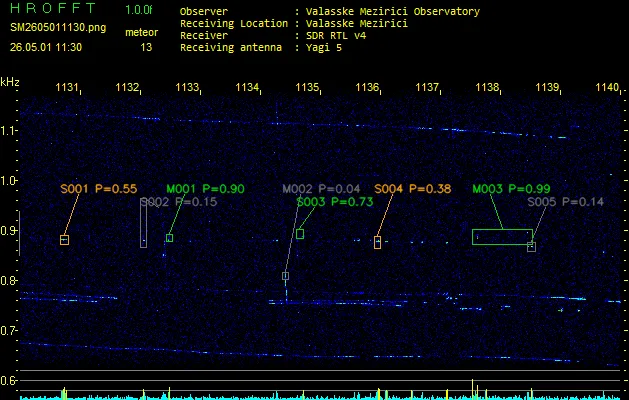
Figure 4: Candidate boxes identified within a complex radiogram structure during strong interference by Candidate Detector v03_7. Author: Jakub Koukal
Boundary candidates form a separate branch. Conventional local-maximum detection is naturally less sensitive at both edges of an image. The solver therefore tests the physical support of edge events separately and may create candidates such as E001 or E002. This recovers meteors that begin just before the boundary of one ten-minute interval or continue into the next image. The module also creates a mandatory annotated_audit folder in which every original candidate box can be checked visually.
Splitter v04a – dividing a complex box
One detected box does not necessarily correspond to one physical meteor. It may contain two short events in succession, a meteor and its afterglow, several partially overlapping echoes, or a meteor embedded in a long interference structure. The Splitter analyses the candidate’s time profile and searches for points where the structure separates naturally into independent components. It produces child boxes with identifiers such as M003A, M003B, and M003C.
A split is deliberately treated as a proposal rather than an automatically valid result. An overly aggressive splitter could divide one long overdense meteor into several nonexistent events. A separate decision module therefore follows it.
Split Decision v04b – how many meteors are actually visible
Split Decision classifies the individual child boxes and assesses their temporal arrangement, mutual separation, and probabilities. It may accept the split, retain the original parent box, or select only certain child boxes. In HROFFT Complex Solver GUI 0.5.3, the topology was generalized to handle cases in which a parent box contains more than two real meteors and some of the proposed components are noise.
This step is critical for statistics. Incorrectly merging two meteors reduces the count, while a false split increases it. The solver therefore uses a precision gate: only child boxes with sufficient probability and valid measurements enter the final topology.
Event Measurement v01_2 – measuring time, duration, and intensity
Once the candidates have been decided, a separate measurement layer analyses the intensity structure inside each box again and determines the event’s beginning and end. An important new feature is the distinction between primary duration and group span. The primary duration describes the meteor’s own physical echo, whereas the group span may include surrounding interference, multiple components, or a long afterglow. The definition of a “bright meteor longer than 10 seconds” uses the primary duration, preventing a short meteor attached to a long Doppler profile from being classified incorrectly as a long event.
The module also measures maximum intensity, integrated intensity, and the event’s total area. Integrated intensity is the sum of the intensity excess across all pixels belonging to the meteor echo and is a more physically useful quantity than the pixel count alone. The measurement also records quality indicators and flags, including vertical correction, local side interference, and multiple temporal components.
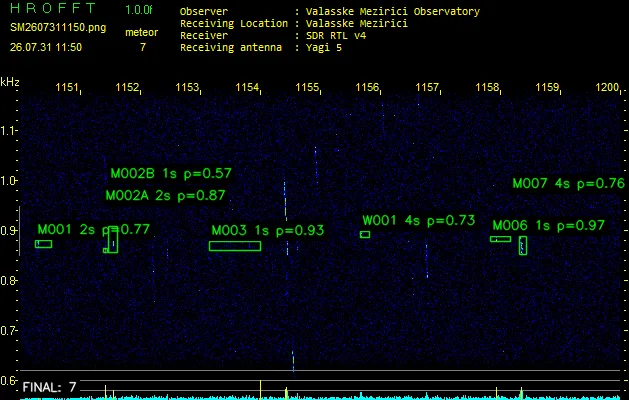
Figure 5: Final radiogram annotation. Green boxes indicate accepted meteor events and show their identifiers, primary durations, and classification probabilities. Author: Jakub Koukal
Canonical Assembler v04c – building an unambiguous catalogue
The Canonical Assembler is the central decision module of the entire solver. It constructs a common catalogue from the original candidates, child boxes, boundary detections, and measurements. Its task is not simply to choose the objects with the highest probabilities. It must determine which boxes represent the same physical event, which merely overlap, and which must remain separate.
Core-aware dedup compares the temporal and spatial structures of the boxes. It suppresses duplicates while protecting two nearby real meteors from being merged incorrectly. In complex cases, it uses parent–child box relationships and information about the event’s measured core. Structured review rescue returns selected bright or physically convincing review candidates to the catalogue without globally lowering the threshold. A separate ultra-strong bolide rescue branch protects extremely bright and extensive fireballs whose morphology may be unusual for the conventional model. Conversely, a narrow thin-long interference veto removes a specific class of flat, elongated interference structures.
Contextual risk from aircraft, photovoltaic interference, and general Doppler profiles is retained only for auditing. Testing showed that these classes vary greatly at a local level and that another hard veto would remove real meteors as well.
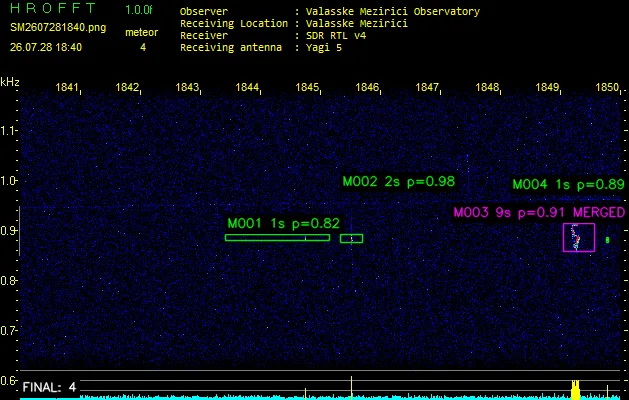
Figure 6: A more complex radiogram containing four final meteors. Purple box M003 was formed by merging two internal representations of the same physical meteor, while the surrounding meteors remained correctly separated. Author: Jakub Koukal
Final export layer v0.5.3 – data ready for analysis
The final layer converts the internal results into stable production files in the FINAL folder. The complete HROFFT_final_events catalogue preserves detailed information about every event’s origin, topology, box, measurements, and decision flags. Times in this catalogue are labelled localtime, because the station computer writes local time—CET or CEST—into the radiogram filenames.
Two reduced outputs are produced for routine analysis. HROFFT_10min_summary contains one row for each ten-minute interval, including intervals with no meteors. It records the actual UTC time, MJD (Modified Julian Date), solar longitude, number of all candidate events, number of final meteors, number of meteors with a primary duration of at least 10 seconds, and sum of integrated intensities. An accompanying plot of meteor counts against MJD makes outages, unusual peaks, and errors in the time sequence immediately visible.
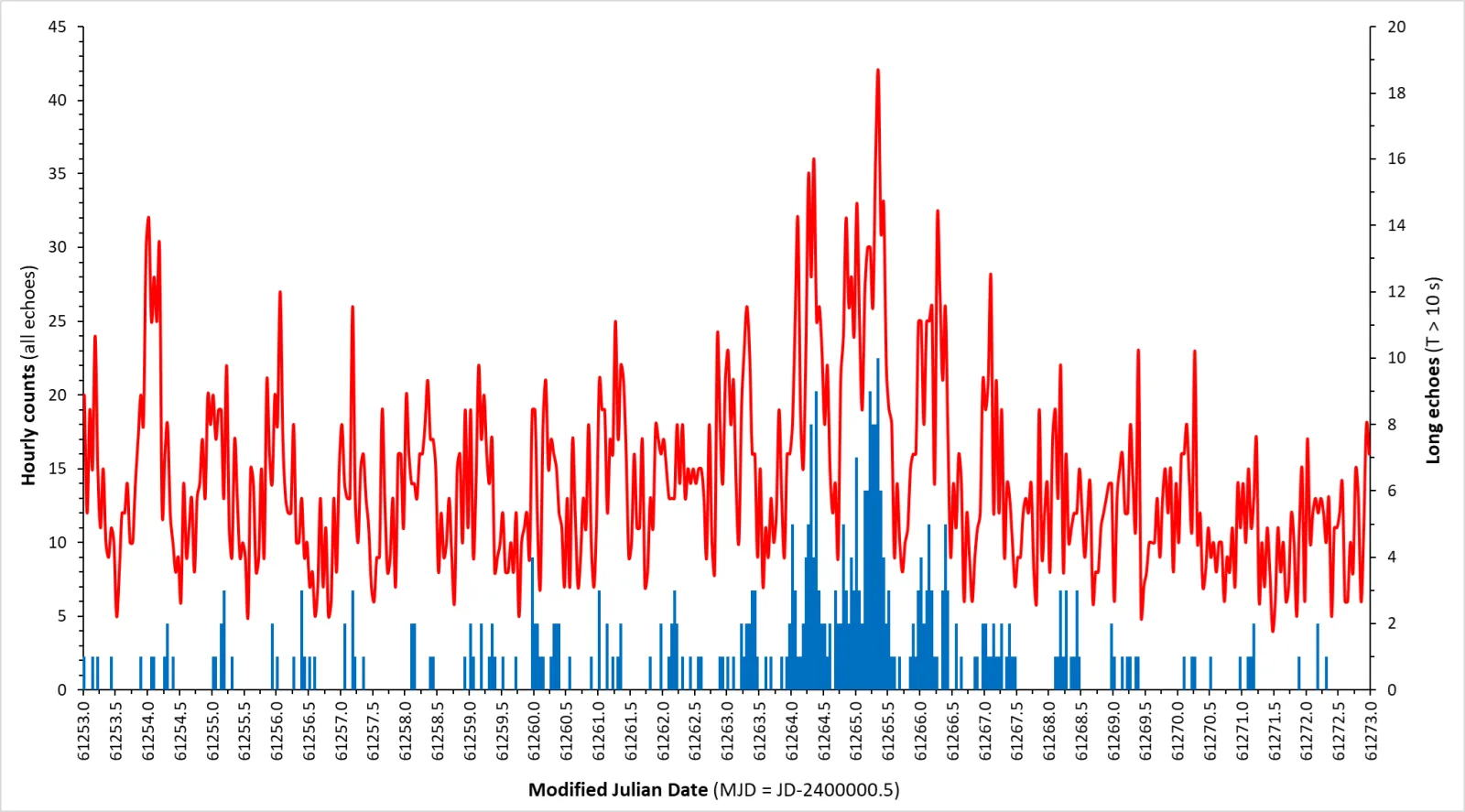
Figure 7: Final radio-meteor counts during the 2026 Perseid maximum. The interval covers August 1–20; the counts are not corrected for radiant altitude above the horizon, sporadic background, or the probability function for meteor detection. The local maximum around MJD 61254.0 belongs to the Southern delta Aquariids (SDA). Author: Jakub Koukal
HROFFT_final_meteors contains one row for every accepted meteor: source image, identifier, UTC start time, MJD, solar longitude, duration, maximum intensity, integrated intensity, and area. Conversion from CET or CEST follows the historical rules of the Europe/Prague time zone.
The autumn clock change requires special attention because the local hour from 02:00 to 02:59 occurs twice. A filename alone cannot reveal whether it refers to daylight-saving time or standard time. The solver therefore does not choose either possible interpretation. UTC, MJD, and solar longitude remain empty, and both possible variants are written to HROFFT_time_ambiguities for manual completion. Once corrected, only the final-export generator needs to be run again; the complete calculation does not need to be repeated.
How HROFFT Complex Solver GUI 0.5.3 was validated
The solver was developed progressively across many independent nights with different levels of meteor activity and different forms of interference. Every structural change was tested retrospectively against previously evaluated cases so that correcting one error did not introduce another. Dedicated regression sets included boundary meteors, overlapping boxes, several meteors inside one parent box, strong fireballs, aircraft, and significant broadband interference.
The decisive production dataset comprised 1,006 fully visually audited radiograms. The final catalogue contained 2,296 events, of which 2,258 were correctly accepted and 38 were confirmed false detections. The catalogue achieved a physical precision of 98.34%. Only one physical false-negative classification was confirmed, corresponding to a hard recall of 99.96%. When two ambiguous topological groups are counted conservatively, hard recall remains 99.87%. In a separate stress set of 80 fireball radiograms, hard recall reached 100%.
The remaining false detections consisted of 17 aircraft, 12 broadband-interference structures, and 9 cases of periodic or photovoltaic interference. These errors represent 1.66% of the production catalogue and have no single local morphology.
The practical result is an automated route from a radiogram to a catalogue suitable for analysing meteor-shower activity. The ten-minute images can be converted into meteor-activity time profiles without manual transcription, separating long and short echoes, following changes in integrated intensity, and relating the results to MJD and solar longitude. This provides a foundation for studying meteor showers, comparing individual maxima, and monitoring the sporadic background over the long term.
HROFFT Complex Solver is not a replacement for physical interpretation. It is a tool that removes the most demanding routine work: finding, measuring, and consolidating thousands of individual structures. This allows us to focus on the scientific questions themselves—when the shower maximum occurred, whether the activity of faint and bright meteors differs, how stable the sporadic background is, and how the character of radio echoes changes over time.
author: Jakub Koukal