
M42 — Orion Nebula
Emission Nebula in Orion
About
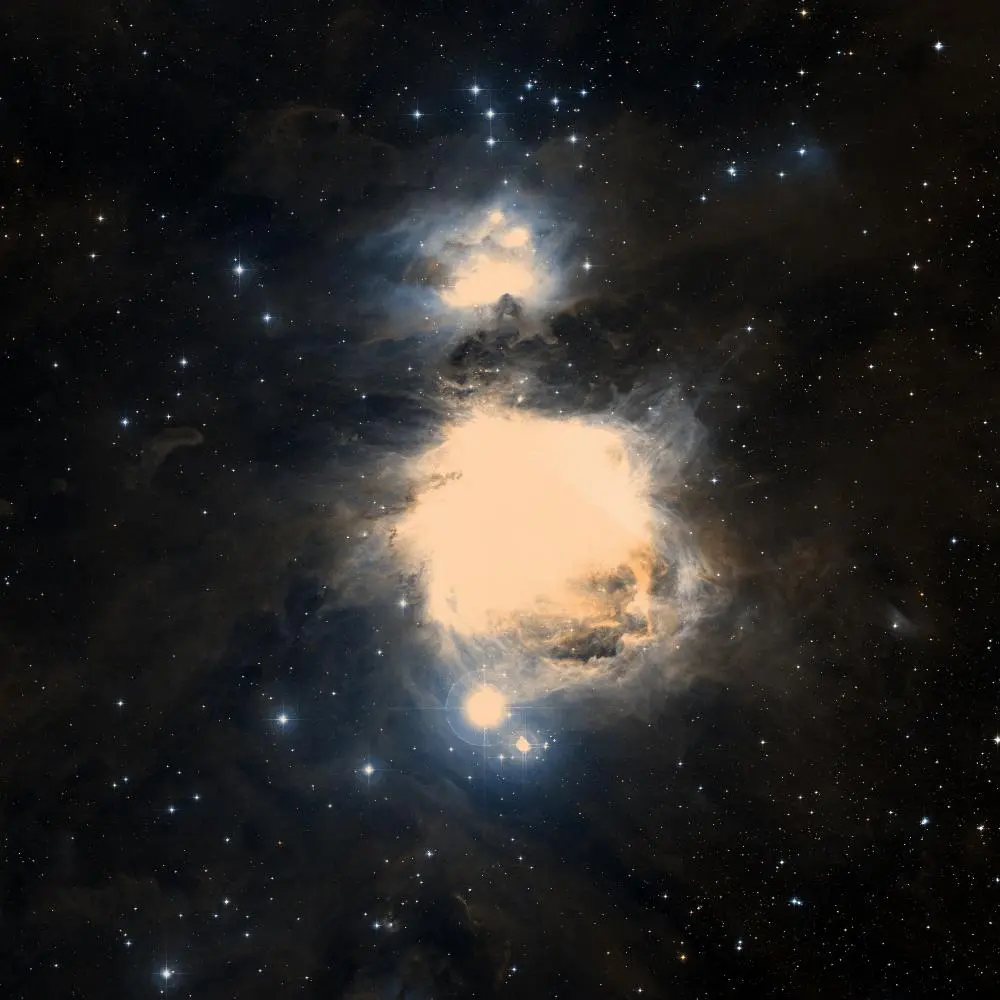
A glowing cloud of gas where new stars are forming, about 1,300 light-years away and the nearest large star-forming region to us. The four young Trapezium stars at its heart sit within a region only 1.5 light-years across and light up the surrounding hydrogen.
Imaging tips
- The core is far brighter than the outer gas and clips in subs of around 15 seconds. Stack short subs (5–10 s) for the Trapezium and longer ones (60 s or more) for the wings, then blend with a mask.
- At 280–480 mm on APS-C the nebula fills a third to half of the frame, with M43 just 8′ away in the same field and the Running Man Nebula about 36′ away.
- A broadband light-pollution filter helps from a suburban sky and keeps natural colours; the nebula is bright enough for a colour camera.
- Best placed in December, when it crosses the meridian around midnight. From 50°N it stays below 35° altitude, so a clear southern horizon matters.
Facts
- Size
- 85′ × 60′
- Magnitude
- 4.0
- Coordinates
- RA 5h 35.3m, Dec −5° 23′
- Framing, APS-C
- 280–480 mm
- Framing, full frame
- 440–730 mm
- Best months
- Dec
- Peak altitude
- 35° from 50°N, 50° from 35°N
Nearby
- M43 (De Mairan's Nebula) · 8.3′ away
- Sh2-279 (Running Man Nebula) · 36.4′ away
- vdB46 · 81.3′ away