
Sh2-188 — Dolphin Nebula
Planetary Nebula in Cassiopeia
About
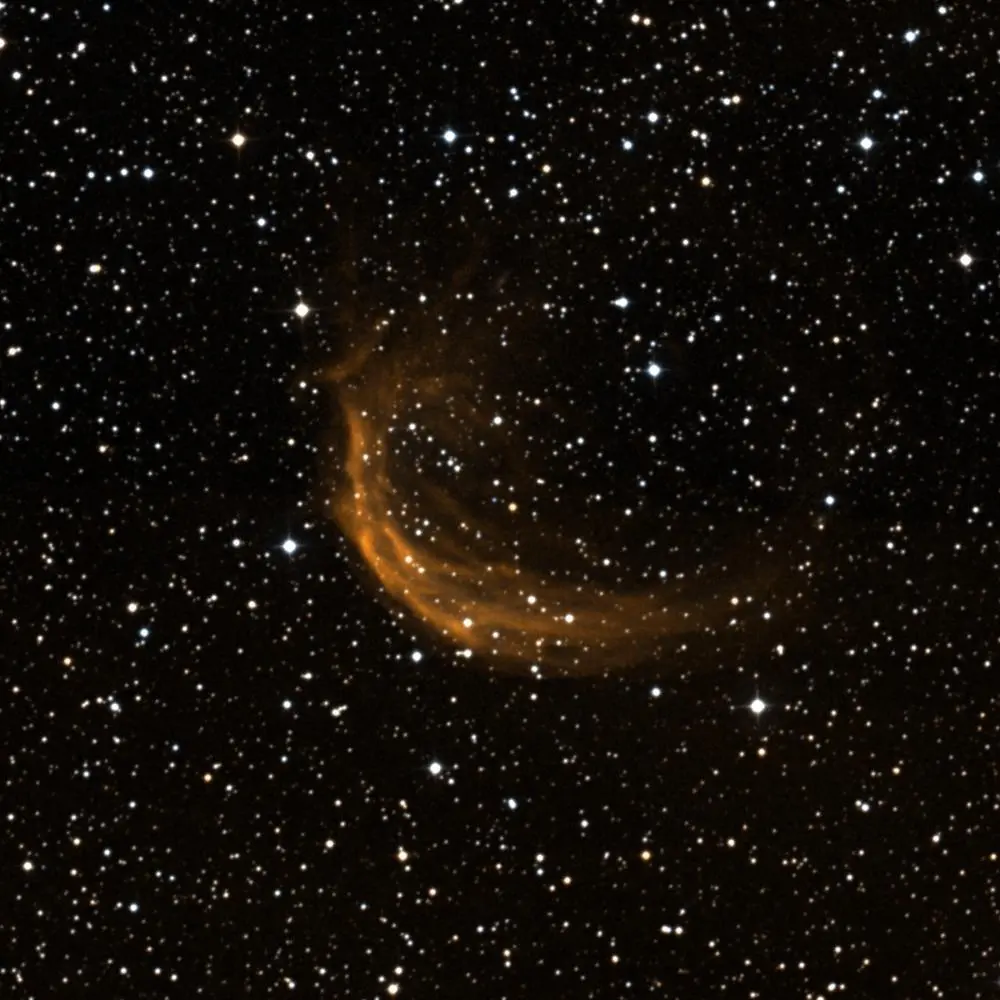
The Dolphin Nebula, also called the Shrimp Nebula: a faint crescent of gas in Cassiopeia, about 715 to 850 light-years away depending on the source. It was first taken for a supernova remnant before being recognised as a planetary nebula. It is moving through space, and its gas piles up against the surrounding material on the side it travels toward.
Imaging tips
- At 3030–5050 mm on APS-C it spans a third to half of the frame, so plan a long focal length and a fine pixel scale.
- Narrowband is the route taken: one imager used 3 nm Hα, SII and OIII filters, with 37 hours 45 minutes in 10-minute frames from a Bortle 9 backyard.
- Dim and small, which one write-up calls challenging for beginners; wildfire smoke left that imager's OIII and SII channels noisy.
- Best in September and October; it peaks near 82° altitude from 50°N.
Facts
- Size
- 8′
- Magnitude
- —
- Coordinates
- RA 1h 30.5m, Dec +58° 25′
- Framing, APS-C
- 3030–5050 mm
- Framing, full frame
- longer than 4000 mm
- Best months
- Sep, Oct
- Peak altitude
- 82° from 50°N, 67° from 35°N