
M64 — Black Eye Galaxy
Galaxy in Coma Berenices
About
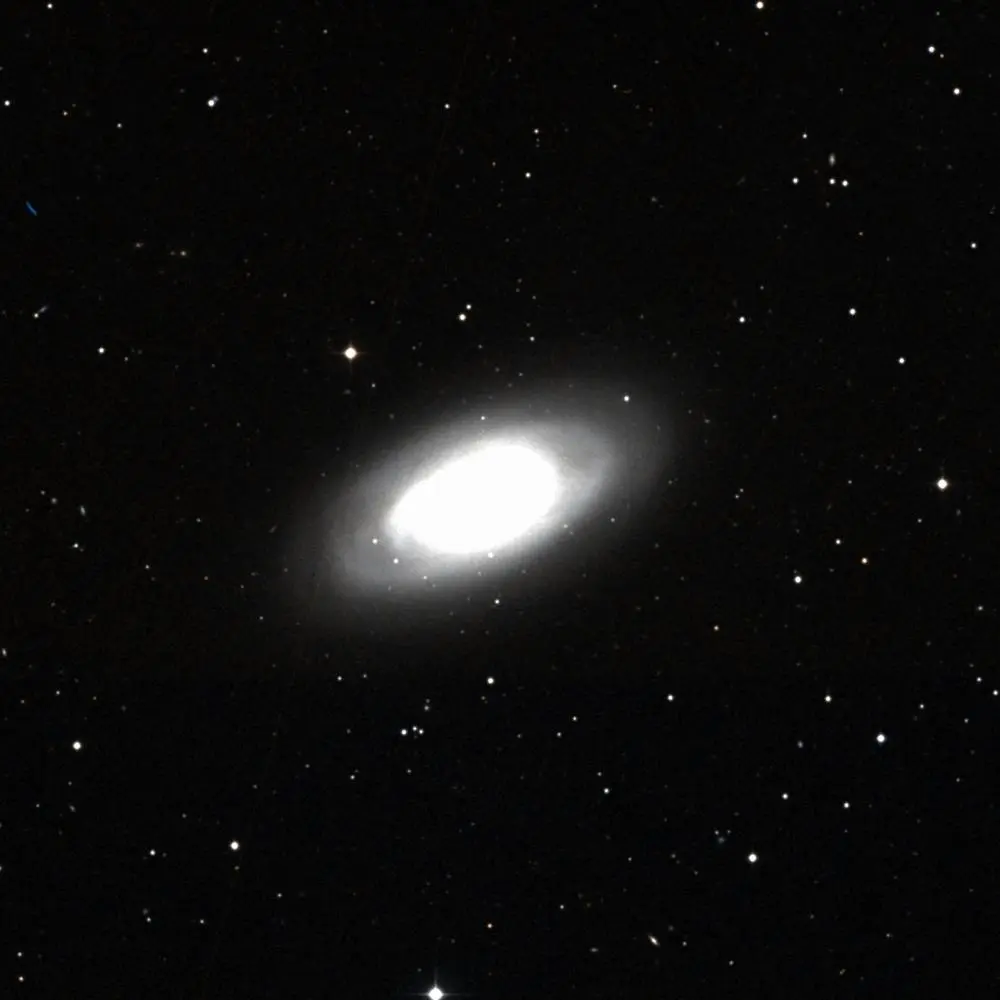
The Black Eye Galaxy, a spiral in Coma Berenices about 17 million light-years away. A dark band of dust in front of the bright nucleus gives it its name. Its gas forms two counter-rotating disks of roughly equal mass.
Imaging tips
- About 10′ by 5′: 2,420–4,040 mm on APS-C spans a third to half of the frame. A short wide-field refractor shows it small, among a rich star field.
- The core is very bright and the dust lanes very dark: a single 5-minute frame showed little, so the stretch must lift the arms while the centre stays below clipping.
- Treat it as broadband. One imager shot a full Moon and found the frames washed out and the arms shifted blue; a moonless night is better.
- A bright star just outside the frame caused artefacts in one 4-hour run, so check what lies near the field edge.
- Best in March and April.
Facts
- Size
- 10′ × 5′
- Magnitude
- 8.5
- Coordinates
- RA 12h 56.7m, Dec +21° 41′
- Framing, APS-C
- 2420–4040 mm
- Framing, full frame
- 3710–6190 mm
- Best months
- Mar, Apr
- Peak altitude
- 62° from 50°N, 77° from 35°N