
M27 — Dumbbell Nebula
Planetary Nebula in Vulpecula
About
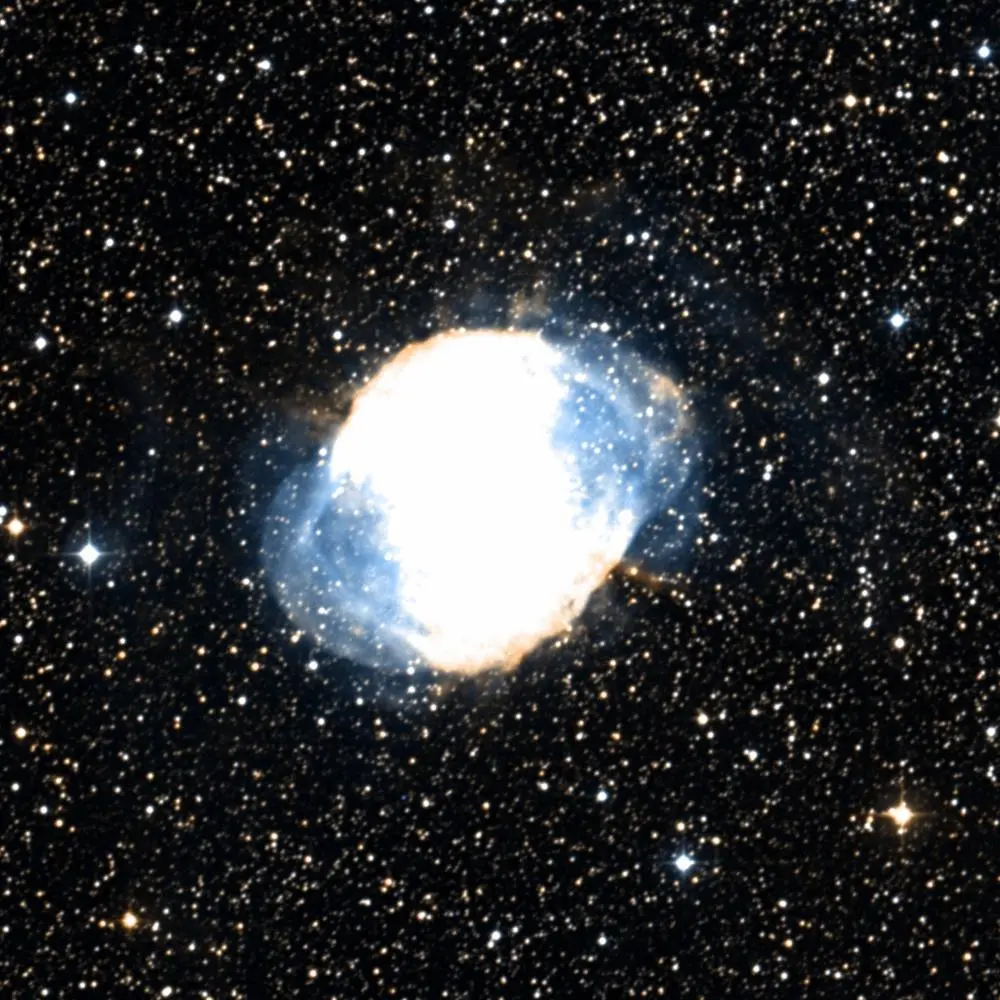
A planetary nebula, the shell shed by a dying Sun-like star, about 1,300 light-years away. It was the first planetary nebula ever found, by Charles Messier in 1764, and is roughly 10,000 years old.
Imaging tips
- Only about 8′ across, a small target: filling a third to half of an APS-C frame takes about 3,030–5,050 mm, so most imagers use a shorter focal length and crop. A 1050 mm setup showed much more detail than 480 mm.
- Hα and OIII bring out the internal structure and the faint outer shell; an HOO palette (OIII to green and blue, Hα to red) is a common choice. Broadband RGB gives natural star colours.
- One narrowband example used 5- and 7-minute subs in Hα and OIII for 6 h 20 min in total; a stock DSLR on an 80 mm refractor got a result from a single 1 h 20 min stack.
- Surface brightness is about 20.2 mag/arcsec², fairly bright. Best placed in July and August in the Summer Triangle.
Facts
- Size
- 8′ × 6′
- Magnitude
- 7.4
- Coordinates
- RA 19h 59.6m, Dec +22° 43′
- Framing, APS-C
- 3030–5050 mm
- Framing, full frame
- longer than 4000 mm
- Best months
- Jul, Aug
- Peak altitude
- 63° from 50°N, 78° from 35°N