
H-NGC7008
Planetary Nebula in Cygnus
About
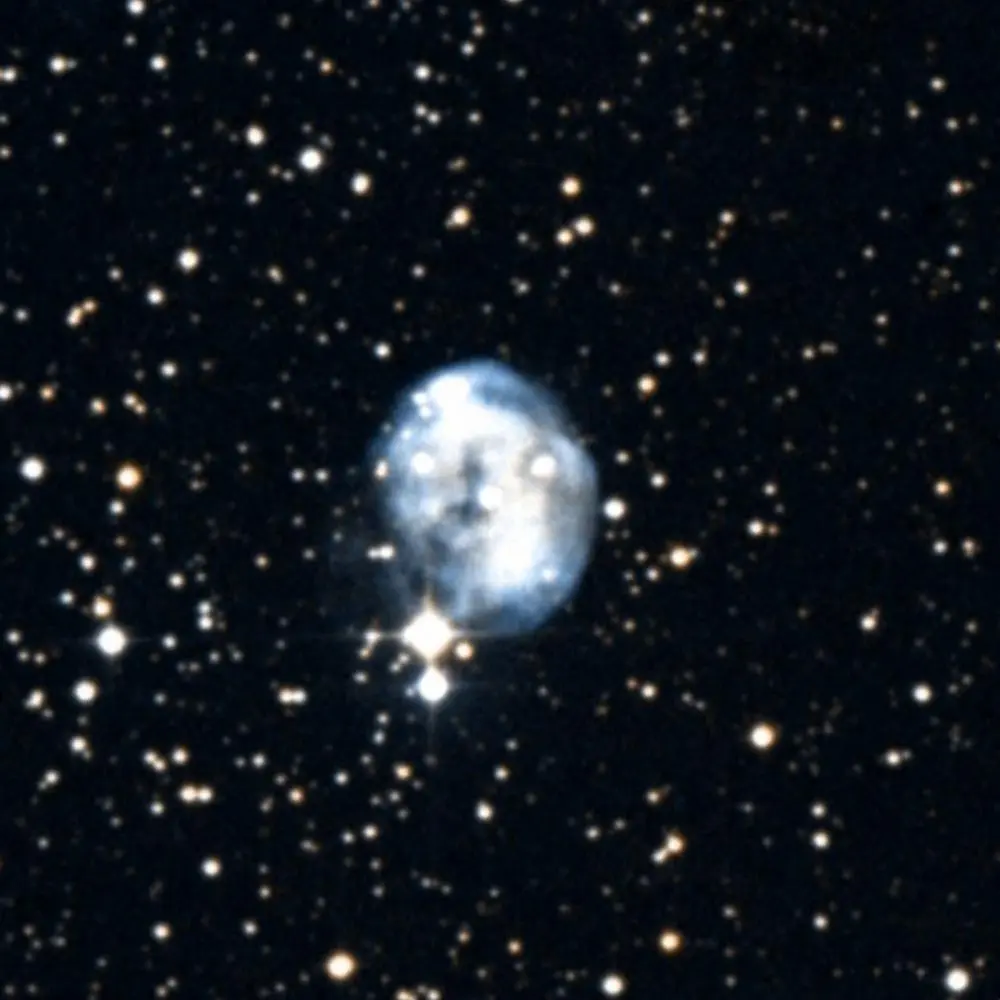
A planetary nebula in Cygnus, about 2,800 light-years away and roughly a light-year across, also called the Fetus Nebula. William Herschel found it in 1787, and it is part of the Herschel 400.
Imaging tips
- Around 1.4′ across, so it is too small to frame: use a long focal length and a fine pixel scale.
- A planetary nebula suits narrowband. One imager made a Hα and OIII image from about 10.5 hours, using 300 s subs on a 260 mm f/5 telescope.
- Another imager gathered 20.3 hours across Hα, OIII and broadband filters at 0.533″ per pixel, with OIII subs of 1800 s and 900 s.
- In the 10.5-hour data the SII channel held little useful detail, so the imager switched from a three-colour SHO palette to Hα plus OIII.
- Best in July and August; it passes almost overhead, peaking near 86° from 50°N.
Facts
- Size
- 1′
- Magnitude
- 10.7
- Coordinates
- RA 21h 0.5m, Dec +54° 33′
- Framing, APS-C
- longer than 4000 mm
- Framing, full frame
- longer than 4000 mm
- Best months
- Jul, Aug
- Peak altitude
- 86° from 50°N, 71° from 35°N