
H-NGC5466
Globular Cluster in Boötes
About
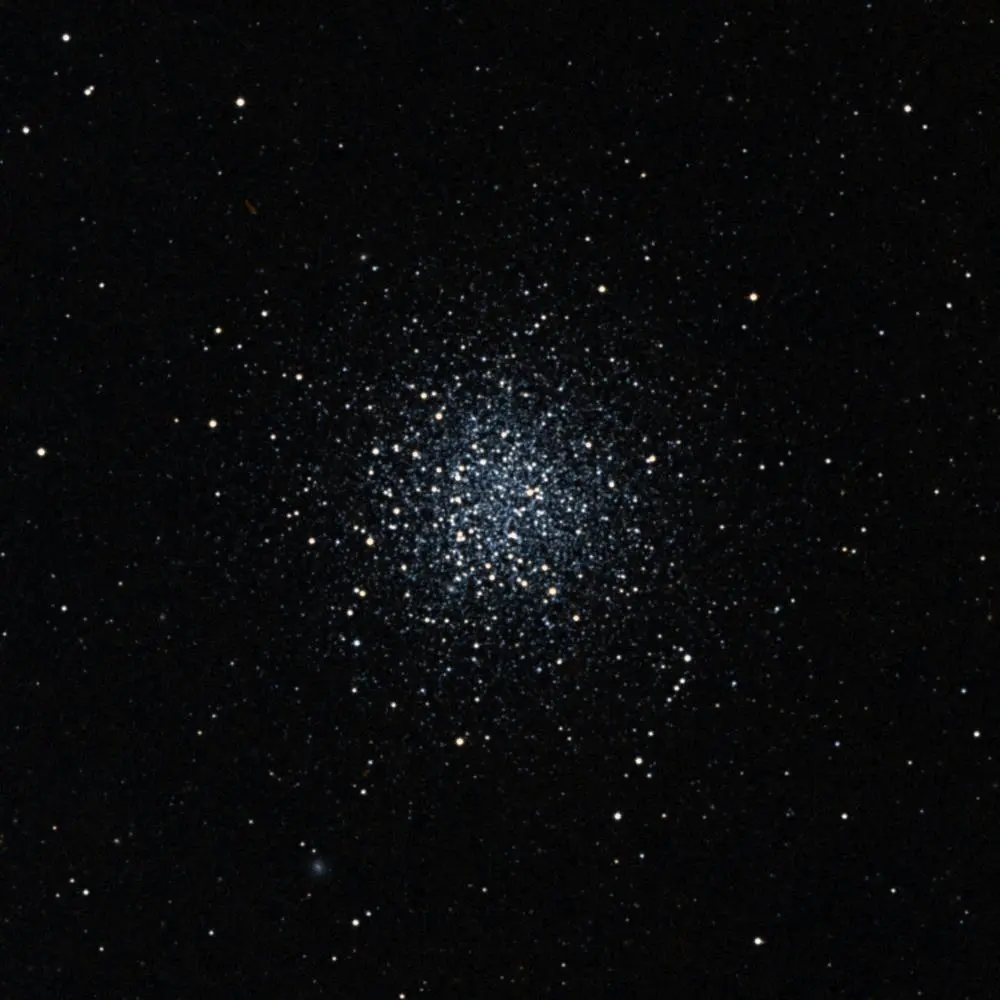
A globular cluster in Boötes about 52,000 light-years away, loose for its brightness and unusually poor in heavy elements. Stars pulled from it form a faint stream that astronomers traced across about 45° of sky in 2006. It is in the Herschel 400, found by William Herschel in 1784.
Imaging tips
- About 9′ across, it takes up a third to half of the frame at 2690–4490 mm on APS-C.
- Surface brightness is 22.4 mag/arcsec², faint for its size, so plan a long run of broadband data; a cluster has no use for narrowband.
- One imager covered a field of roughly 20 × 21′ in 60 minutes of LRGB in total; a faint spiral galaxy, MCG 5-33-43, sat beside the cluster in that frame.
- Its stream is about 45° long and roughly ten times more tenuous than the one from Palomar 5, far beyond what a single frame holds.
- Best around April and May, peaking near 68° altitude from 50°N.
Facts
- Size
- 9′
- Magnitude
- 9.0
- Coordinates
- RA 14h 5.5m, Dec +28° 32′
- Framing, APS-C
- 2690–4490 mm
- Framing, full frame
- longer than 4000 mm
- Best months
- Apr, May
- Peak altitude
- 69° from 50°N, 84° from 35°N