
H-NGC3938
Galaxy in Ursa Major
About
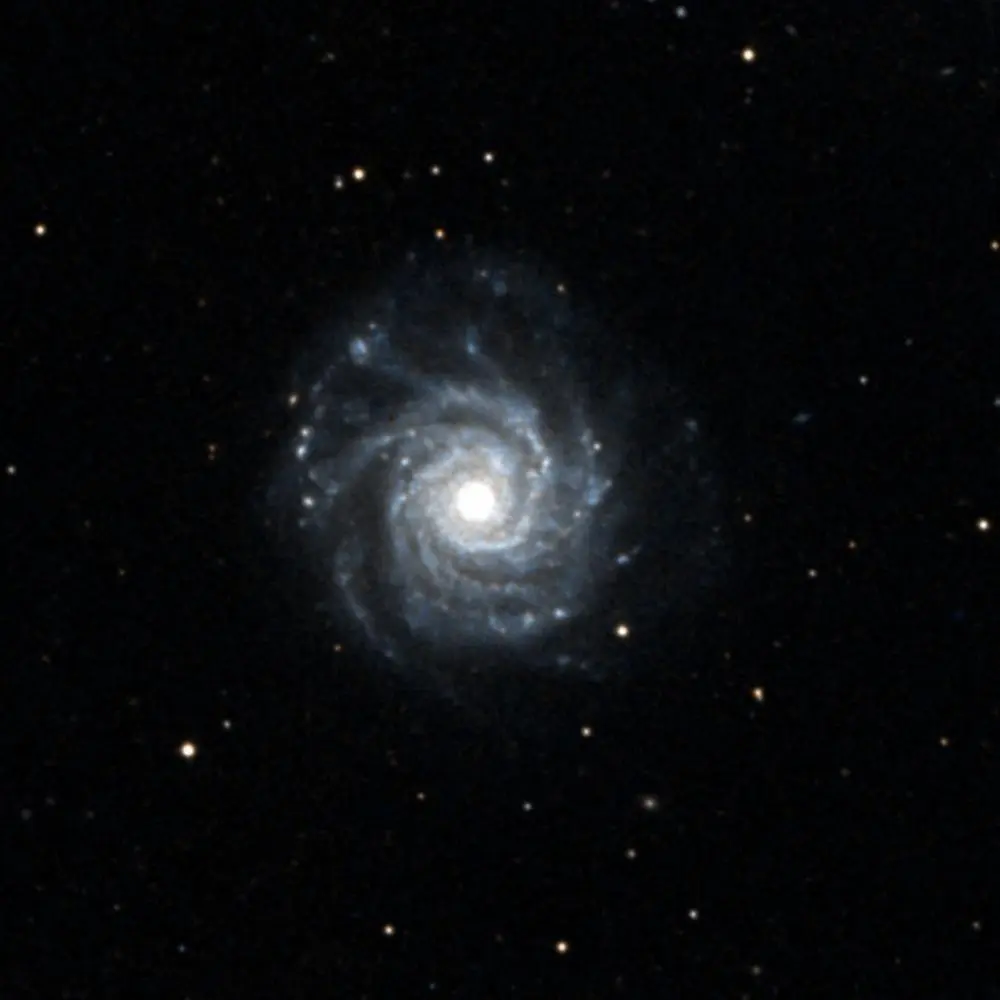
A spiral galaxy in Ursa Major seen face-on, about 41 million light-years away. Five supernovae have been found in it between 1961 and 2022. William Herschel discovered it in 1788, and it belongs to the Herschel 400 list.
Imaging tips
- Only about 5′ across, so it is too small to frame: use a long focal length and a fine pixel scale.
- At 22.5 mag/arcsec² it is on the faint side. One imager gathered about 8.4 hours of LRGB, 4.5 of them luminance, with a 32-inch telescope.
- A 12′ field and a 20-minute luminance plus 20 minutes of colour from a 20-inch telescope already showed knotty arms and thin dust lanes in the inner disk.
- Best around February to April; it peaks near 84° from 50°N.
Facts
- Size
- 5′ × 5′
- Magnitude
- 10.4
- Coordinates
- RA 11h 52.8m, Dec +44° 7′
- Framing, APS-C
- longer than 4000 mm
- Framing, full frame
- longer than 4000 mm
- Best months
- Feb, Mar, Apr
- Peak altitude
- 84° from 50°N, 81° from 35°N