
H-NGC2683 — UFO Galaxy
Galaxy in Lynx
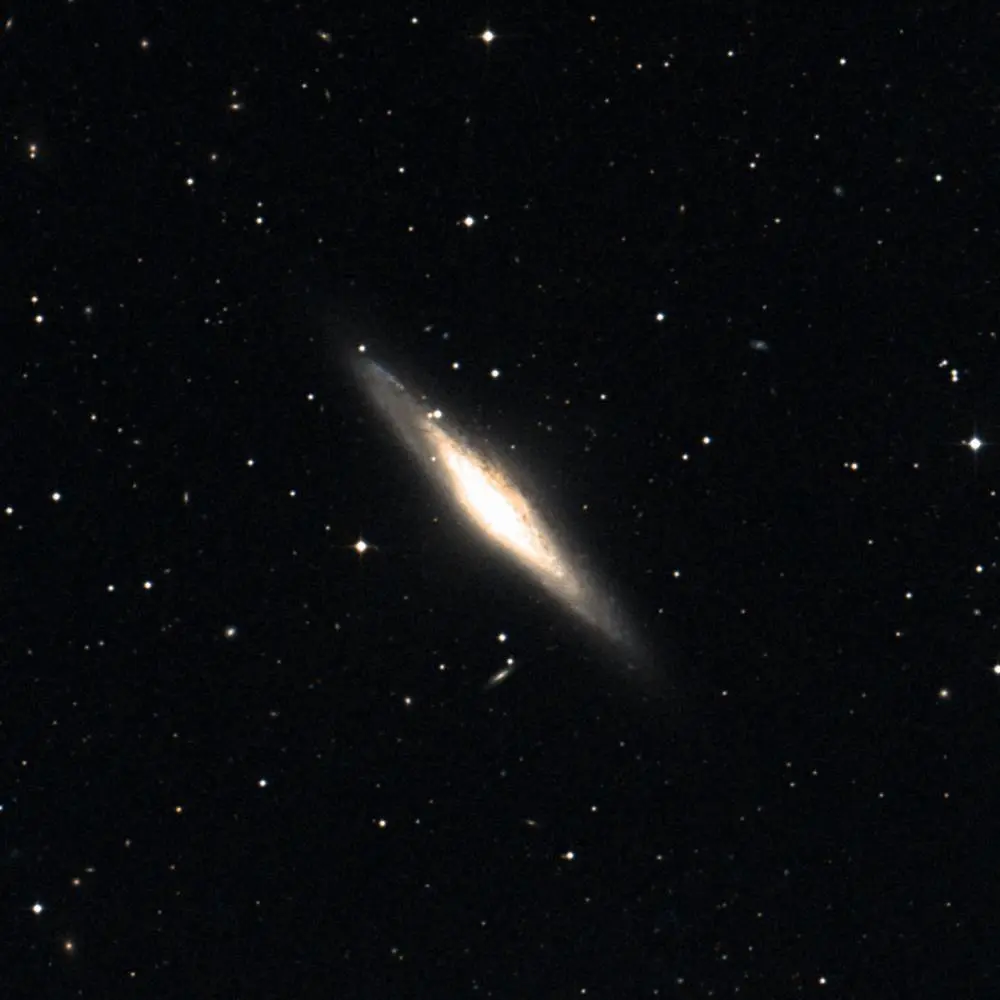
About
An edge-on spiral in Lynx, nicknamed the UFO Galaxy, at a distance near 30 million light-years and roughly 122,000 light-years across. It carries around 300 globular clusters, twice the Milky Way's count, and its largest known satellite is the dwarf KK 69. William Herschel found it in 1788; it is in the Herschel 400.
Imaging tips
- A thin sliver about 9′ long: 2690–4490 mm on APS-C frames it, so it needs a long focal length.
- Surface brightness is 21.5 mag/arcsec². One imager gathered 17 h 36 min: 66 × 8 min of luminance and 22 × 8 min per colour.
- That 1490 mm frame also shows 14 globular clusters in the halo and two dwarf companions.
- Another imager reached 8 h 50 min of LRGB, mostly in 300 s subs.
- Best around January and February; it peaks near 73° altitude from 50°N.
Facts
- Size
- 9′ × 2′
- Magnitude
- 9.7
- Coordinates
- RA 8h 52.7m, Dec +33° 25′
- Framing, APS-C
- 2690–4490 mm
- Framing, full frame
- longer than 4000 mm
- Best months
- Jan, Feb
- Peak altitude
- 73° from 50°N, 88° from 35°N