
H-NGC1545
Open Cluster in Perseus
About
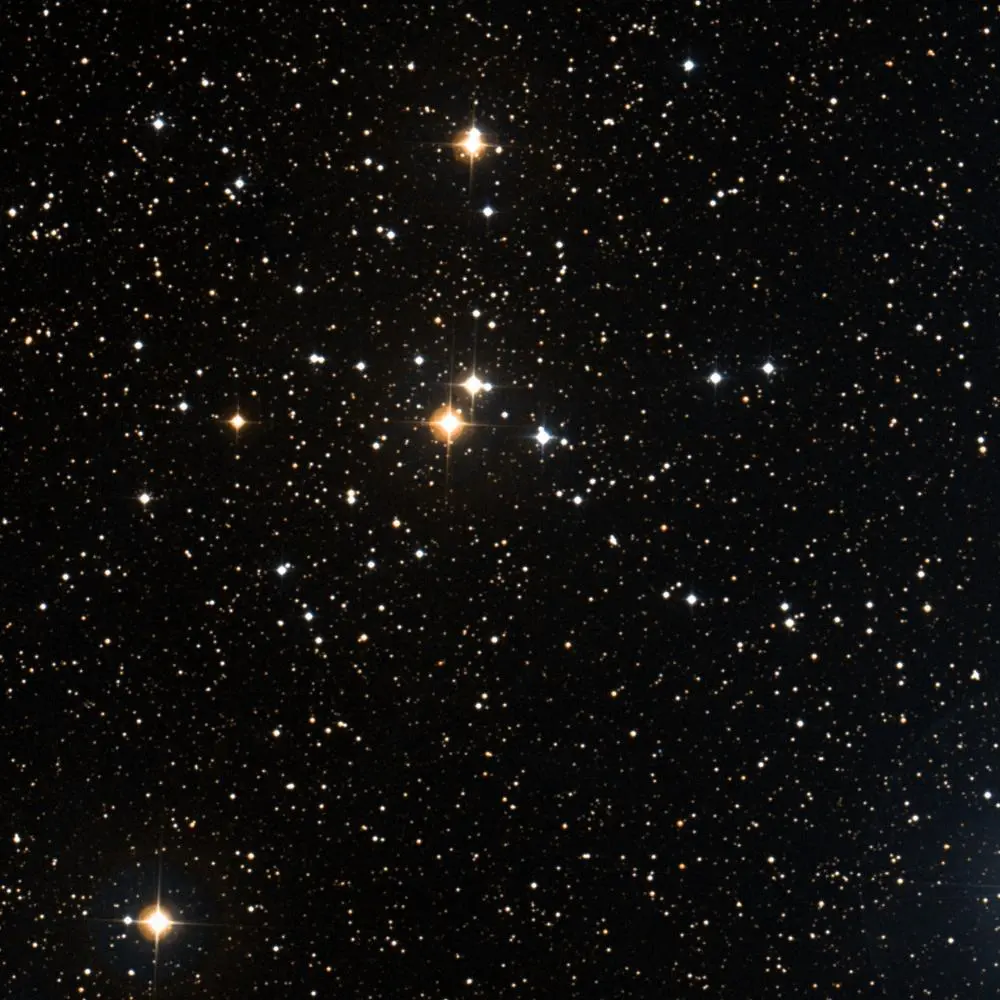
An open cluster in Perseus, found by William Herschel in 1790 and also listed as Collinder 49. It is about 2,300 light-years away and roughly 280 million years old. Its brightest star is a K-type giant of magnitude 7.1, though membership is uncertain.
Imaging tips
- Sources give about 18′ across: 2020–3370 mm on APS-C, or 3090–5160 mm on full frame, frames it.
- Surface brightness is 20.2 mag/arcsec². One page counts about 40 stars visible in a medium-sized telescope, so it is a coarse, sparse cluster.
- One imager combined 12 × 4 min luminance with 8 × 2 min per colour channel with a 106 mm f/5 refractor, covering a 55′ field.
- The central star and the brighter half of a double at the northern edge have an orange tint, so colour data is worth keeping.
- NGC 1528, denser and richer, is about 1.3° to the northwest, so a wider field is needed for both. Best in November and December.
Facts
- Size
- 12′
- Magnitude
- 6.2
- Coordinates
- RA 4h 20.8m, Dec +50° 13′
- Framing, APS-C
- 2020–3370 mm
- Framing, full frame
- 3090–5160 mm
- Best months
- Nov, Dec
- Peak altitude
- 90° from 50°N, 75° from 35°N