
H-NGC1513
Open Cluster in Perseus
About
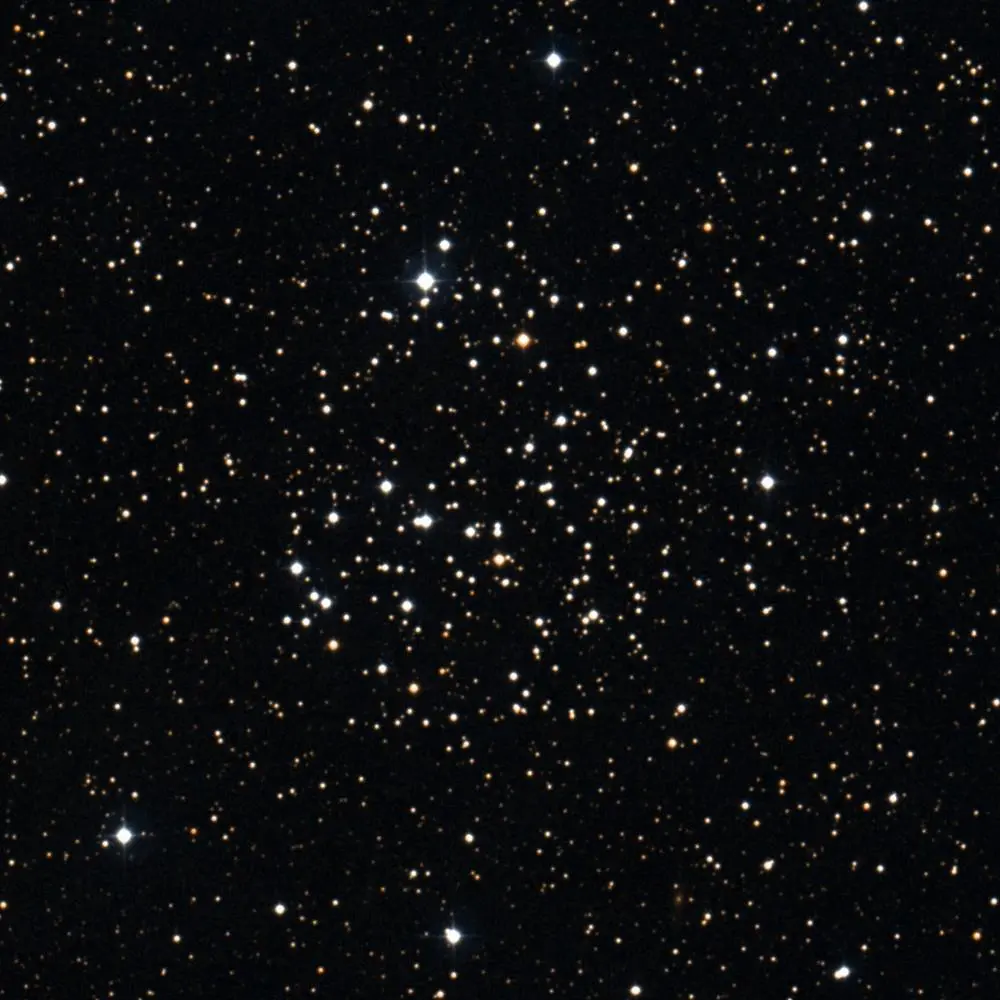
An open cluster in Perseus, discovered by William Herschel in 1790, about 4,800 light-years away. Dust from the Perseus dark cloud complex partly obscures it, and its brightest member is only around magnitude 11. It is also in the Herschel 400.
Imaging tips
- A compact target, about 9′ across: 2690–4490 mm on APS-C frames it, and it is too small to fill a frame from a short lens.
- Surface brightness is 21.8 mag/arcsec² and the brightest member is only near magnitude 11, so expect faint stars to need real integration time.
- One observatory image used a single 10-minute CCD exposure at f/4 on a 20-inch telescope and covered about 16′ × 16′.
- The bright star at the bottom of that frame is a B-type giant about 1,125 light-years away, probably a foreground star rather than a member.
- Best in November and December, when it passes almost overhead (about 89° altitude) from 50°N.
Facts
- Size
- 9′
- Magnitude
- 8.4
- Coordinates
- RA 4h 9.9m, Dec +49° 30′
- Framing, APS-C
- 2690–4490 mm
- Framing, full frame
- longer than 4000 mm
- Best months
- Nov, Dec
- Peak altitude
- 90° from 50°N, 76° from 35°N