
H-NGC1502 — Kemble's Cascade Cluster
Open Cluster in Camelopardalis
About
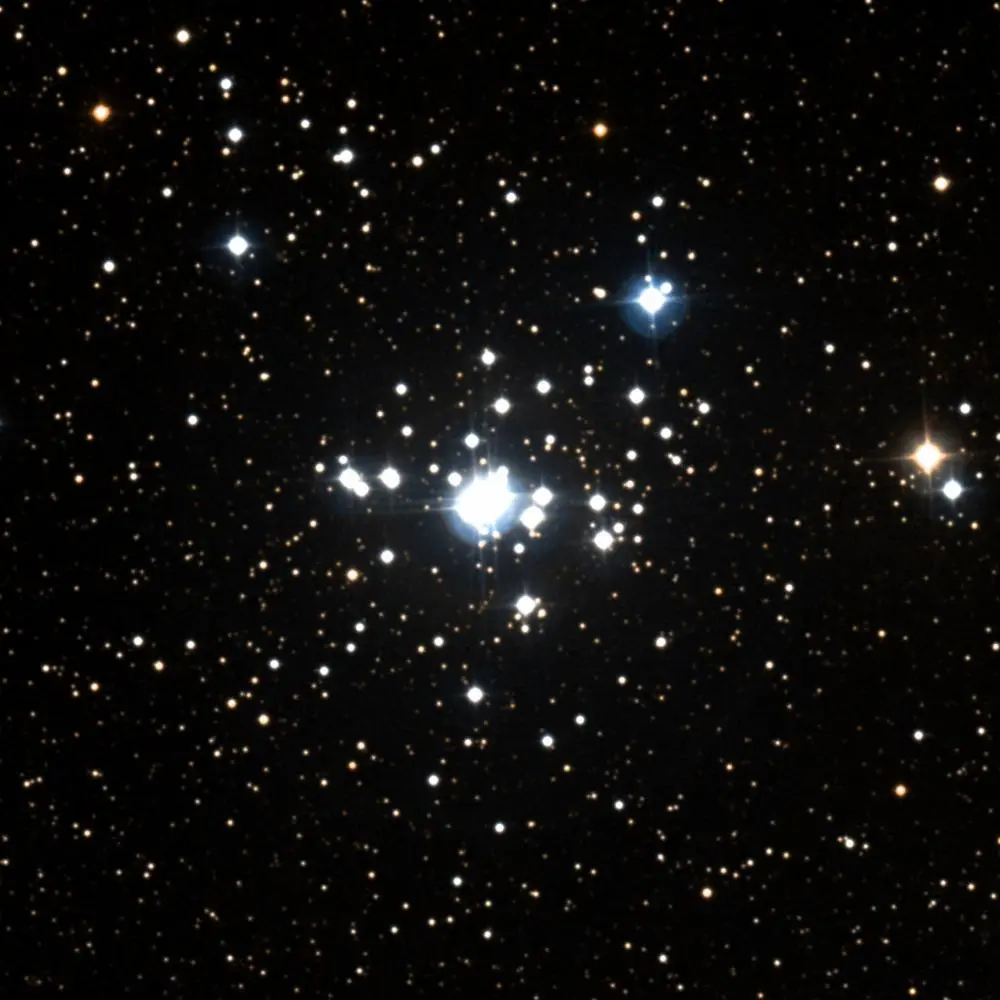
William Herschel found NGC 1502, the Golden Harp Cluster, in 1787. Around 60 stars make up this young group in Camelopardalis, which sources place 2,700–3,600 light-years away. Kemble's Cascade, a string of stars, ends at it, but the line-up is coincidental.
Imaging tips
- The cascade runs about 1° northwest and 1.5° southeast of its central star HIP 18505 (magnitude 4.9), so framing it needs a wide field.
- For the cluster alone, 3030–5050 mm on APS-C works; the cluster holds many close double stars.
- One film image used an 8-inch f/1.5 Schmidt camera, 6 minutes unfiltered, and shows the whole chain ending at the cluster.
- Brightness is 18.8 mag/arcsec². Best in November and December, peaking near 78° from 50°N.
Facts
- Size
- 8′
- Magnitude
- 5.7
- Coordinates
- RA 4h 7.8m, Dec +62° 20′
- Framing, APS-C
- 3030–5050 mm
- Framing, full frame
- longer than 4000 mm
- Best months
- Nov, Dec
- Peak altitude
- 78° from 50°N, 63° from 35°N