
C63 — Helix Nebula
Planetary Nebula in Aquarius
About
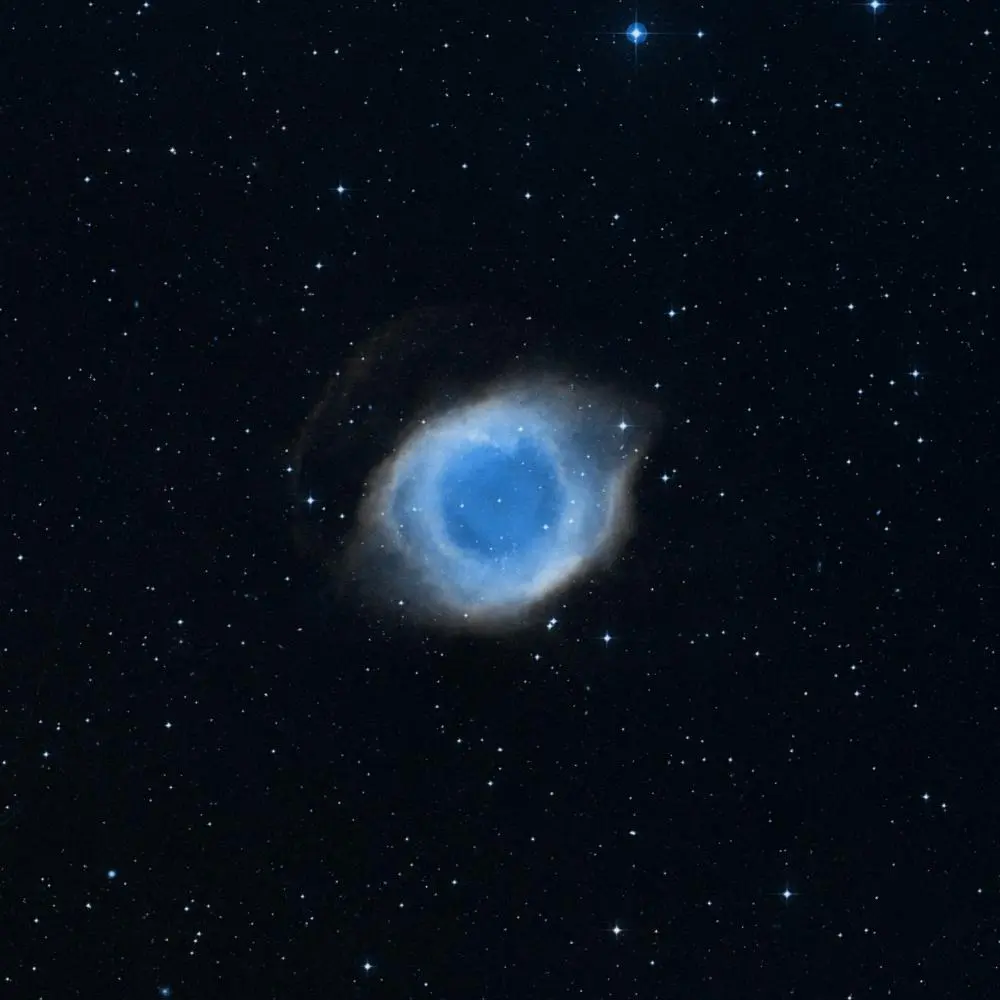
The Helix Nebula, a planetary nebula in Aquarius about 650 light-years away, among the closest bright ones to Earth. It is a shell of gas shed by a dying star, now a white dwarf, and it holds some 40,000 cometary knots.
Imaging tips
- At 970–1,620 mm on APS-C the nebula spans a third to half of the frame, so a long focal length suits it.
- A filter is optional: one imager says none is needed. Adding Hα and OIII brings out the faint outer gas; in his test OIII showed only the inner part.
- The centre is not bright, so a blown-out core is unlikely. Ten-minute subs were called a good all-round length; one 17.5-hour image was called short, and several more hours were suggested for the outer gas.
- Best in August and September, and low: it stays below 19° from 50°N, and one imager cut a session short as it sank too low.
Facts
- Size
- 25′
- Magnitude
- 7.3
- Coordinates
- RA 22h 29.6m, Dec −20° 50′
- Framing, APS-C
- 970–1620 mm
- Framing, full frame
- 1490–2480 mm
- Best months
- Aug, Sep
- Peak altitude
- 19° from 50°N, 34° from 35°N