
C59 — Ghost of Jupiter
Planetary Nebula in Hydra
About
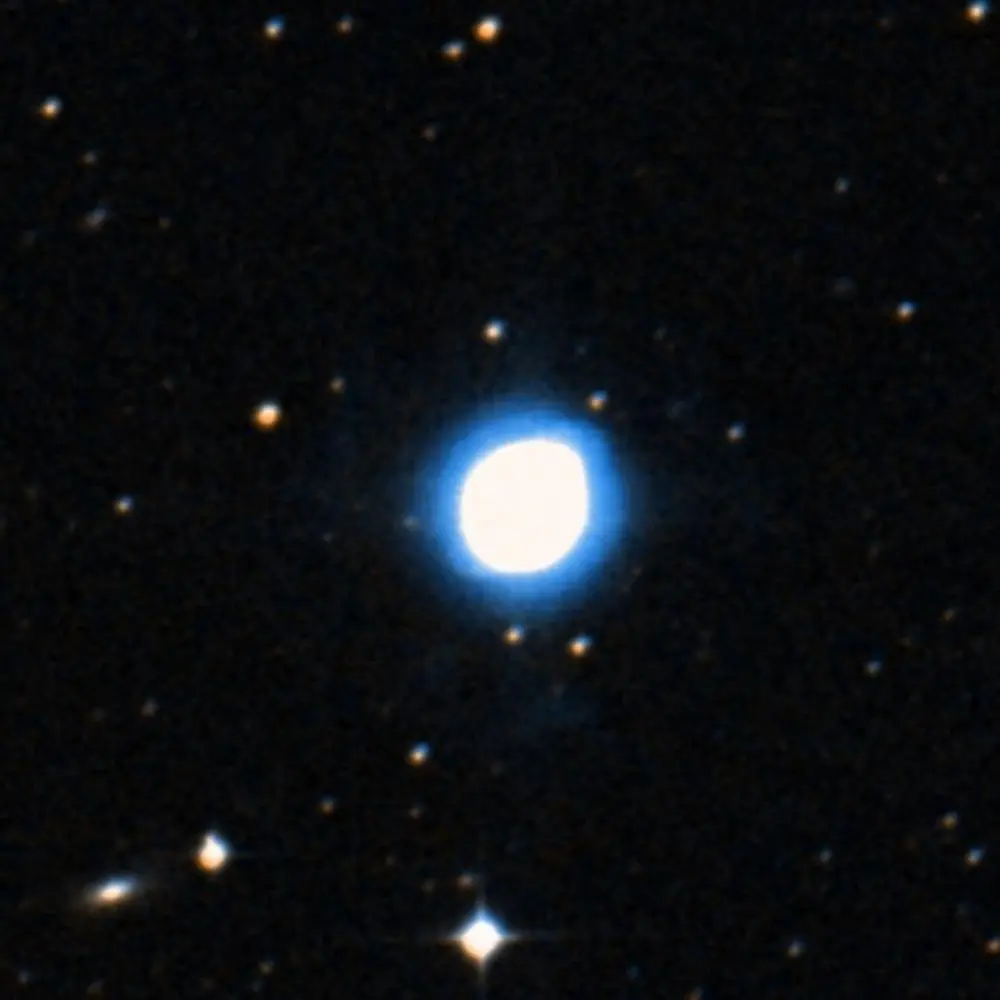
In Hydra, roughly 4,800 light-years away, lies a planetary nebula with the nickname Ghost of Jupiter: the shell of gas shed by a dying star, with inner layers about 1,500 years old and a faint outer halo. William Herschel discovered it in 1785.
Imaging tips
- Too small to frame (about 40″ across by one count): it needs a long focal length and a fine pixel scale.
- A narrowband set suits it. One 20-hour project used Hα and OIII with short RGB frames to colour the stars.
- The core is far brighter than the outskirts: 30-minute subs gave the faint outer gas but erased the core, so shoot 5-minute and 1-minute frames too and blend them.
- Long data can show a faint halo around the bright shell; one 40-hour image did, though its origin is unclear.
- Best around February and March; it peaks near 21° altitude from 50°N.
Facts
- Size
- 2′
- Magnitude
- 8.6
- Coordinates
- RA 10h 24.8m, Dec −18° 39′
- Framing, APS-C
- longer than 4000 mm
- Framing, full frame
- longer than 4000 mm
- Best months
- Feb, Mar
- Peak altitude
- 21° from 50°N, 36° from 35°N