
C49 — Rosette Nebula
Emission Nebula in Monoceros
About
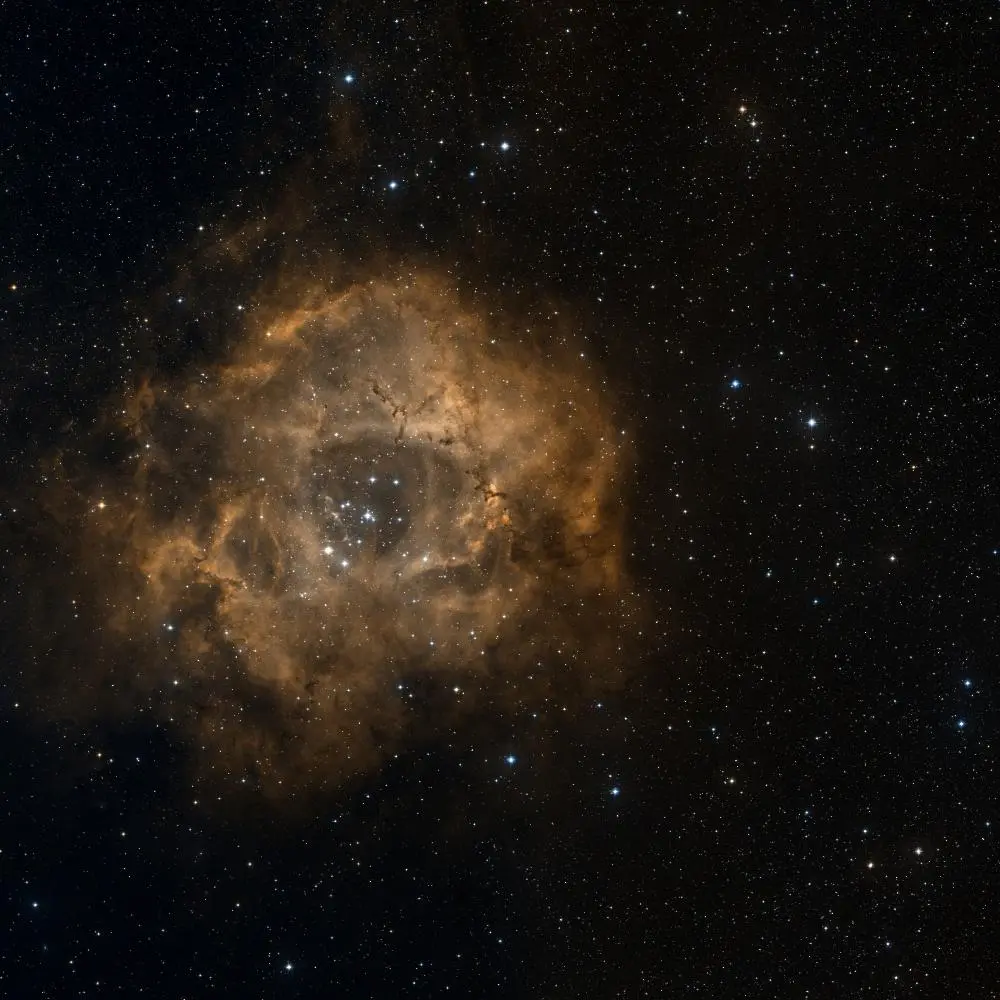
A ring of glowing hydrogen in Monoceros, about 5,200 light-years away and roughly 130 light-years across. The young cluster NGC 2244 (C50) sits in its hollow centre, and two O-type stars there, HD 46223 and HD 46150, supply most of the ionising light.
Imaging tips
- At 300–500 mm on APS-C the 80′ × 60′ nebula spans a third to half of the frame, with the cluster C50 only 23′ from its centre; a 135 mm lens has also been used to add the Christmas Tree Cluster.
- Hα carries by far the most signal, so a narrowband or dual-band filter suits it; adding OIII (and SII) brings out colour contrast.
- A sensitive camera records it quickly: one imager gathered 4 hours of 5-minute subs under a Bortle 9 sky, another used a light-pollution filter.
- The open cluster Cr97 lies 57′ away, so it falls in a wider field rather than the same frame.
- A winter target, best around December and January, peaking near 45° altitude from 50°N.
Facts
- Size
- 80′ × 60′
- Magnitude
- —
- Coordinates
- RA 6h 30.6m, Dec +4° 59′
- Framing, APS-C
- 300–500 mm
- Framing, full frame
- 460–770 mm
- Best months
- Jan, Dec
- Peak altitude
- 45° from 50°N, 60° from 35°N