
C31 — Flaming Star Nebula
Emission Nebula in Auriga
About
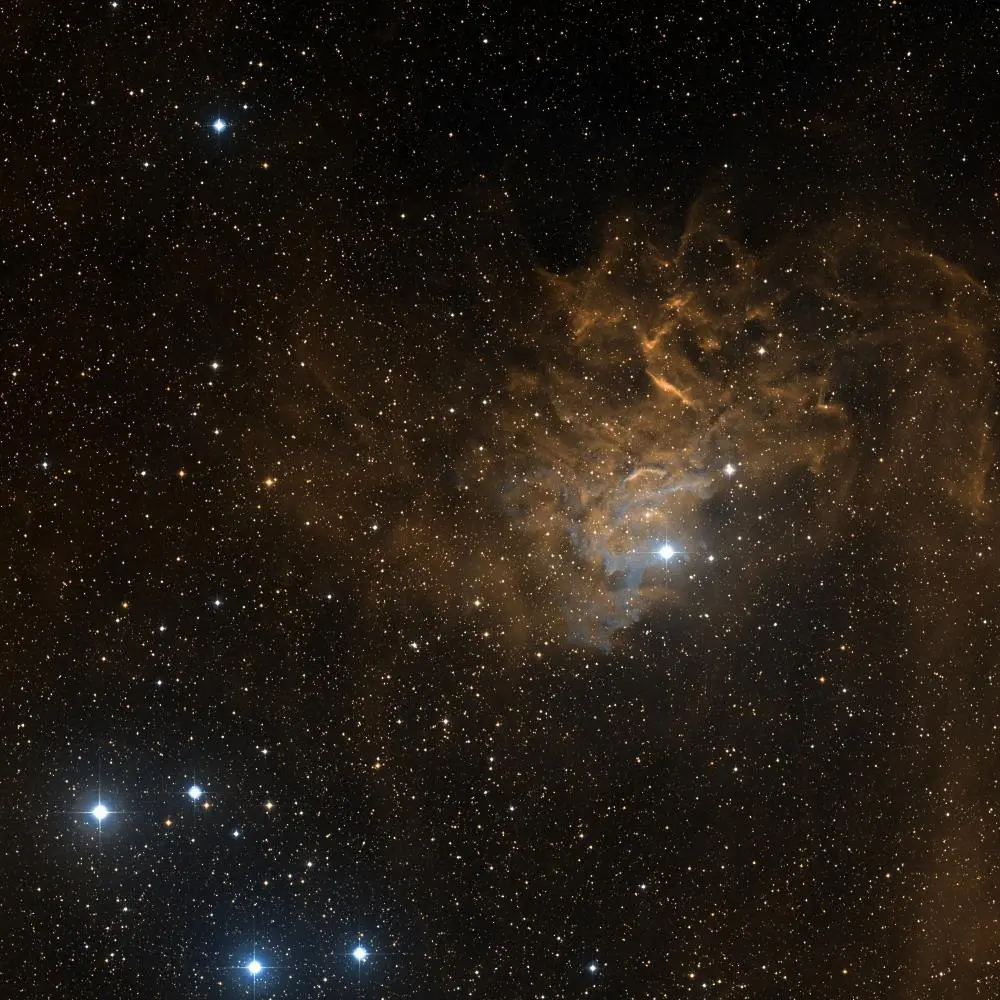
The star AE Aurigae, an irregular variable, lights this cloud of gas and dust in Auriga, some 1,500 light-years from Earth. Tracing the star's motion backwards leads toward the area around Orion's Belt.
Imaging tips
- At 650–1,090 mm on APS-C it spans about 37′ by 19′ and fills a third to half of the frame; full frame needs 1,000–1,670 mm.
- Mixed emission and reflection light: the red glow suits Hα and dual-band filters, but the reflection part needs broadband data.
- One imager used two dual-band filters, Ha/OIII and SII/OIII, to collect extra OIII, the channel that tends to come out weakest.
- Narrowband totals in published images run from about 11 hours to 30 hours, and a colour palette is a choice: the nebula looks red in reality.
- Best in November and December, peaking near 74° altitude from 50°N.
Facts
- Size
- 37′ × 19′
- Magnitude
- —
- Coordinates
- RA 5h 17.4m, Dec +34° 23′
- Framing, APS-C
- 650–1090 mm
- Framing, full frame
- 1000–1670 mm
- Best months
- Nov, Dec
- Peak altitude
- 74° from 50°N, 89° from 35°N
Nearby
- Sh2-229 (Flaming Star Region) · 17.0′ away